


Disclaimer: The views expressed here are my own and do not represent the views or policies of any organization with which I am affiliated.
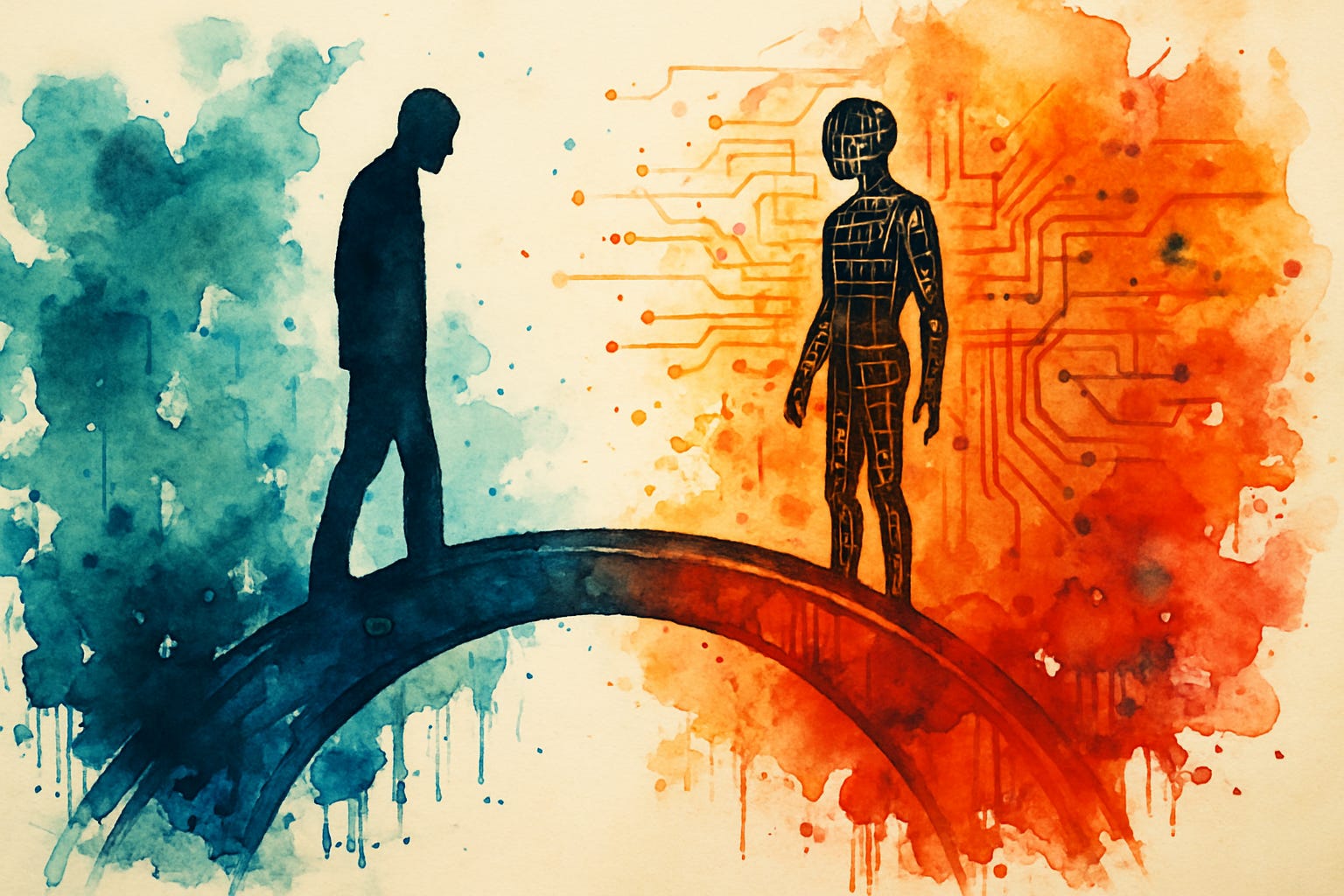
Introduction: The Bridge That No Longer Reaches the Other Side
Every interface begins with a metaphor. We drag files to the trash. We shop with carts that never fill and cut with scissors that never dull. These gestures are not decorative conveniences. They are how humans make the abstract usable.
Jakob Nielsen’s essay “Metaphor in UX Design” reminds us why metaphors are the foundation of usability. They allow people to understand digital actions through analogies drawn from familiar physical experiences. The desktop folder, the shopping cart, and the clipboard are effective because they map new concepts onto old schemas.
But Nielsen’s framework is built on a silent assumption: the user is human. The “cognitive bridge” works because both sides share the same kind of mind. That assumption is now being challenged.
Artificial intelligence systems already operate within digital environments that were originally designed for human use. They summarize records, schedule appointments, and submit data. Whether through direct integration or browser automation, they perform user actions. When systems are shared between human and non-human actors, the old metaphors begin to crack.
The question is not only whether our metaphors will still be effective, but also whether they are even legible to the next kind of user.
I. The Human Foundations of Metaphor
Nielsen’s argument rests on a principle from cognitive linguistics: human understanding is embodied. We reason through metaphor because we experience the world through our senses and movement. A metaphor succeeds when it aligns with those embodied patterns.
This is why the “desktop” worked. It drew on the familiar act of placing, stacking, and retrieving objects from a workspace. The digital action became comprehensible because it resembled a physical one.
The same logic underpins nearly every interface we use today. We “open” files, “click” buttons, and “scroll” through lists. The actions are symbolic, but their success depends on how well they mirror real-world behaviors.
AI systems, however, do not experience the world. They have no sensory input, no memory of gravity or texture. Their reasoning is not analogical but statistical. Where humans build mental models through analogy, AI systems construct probabilistic associations.
In Nielsen’s terms, they have no cognitive bridge to cross. The metaphor does not simplify; it disappears.
II. The Limits of Human Metaphor
Human-centered metaphors have long served as the foundation of usability. They enable a person to act without requiring a technical understanding. A trash can means “discard.” A folder means “contain.” These mappings make invisible systems visible.
Yet those same metaphors depend on shared sensory and cultural context. Remove that context, and the metaphor collapses into arbitrary shapes.
AI systems encounter this problem constantly. A model trained to read user interfaces can identify icons, buttons, and fields, but it does not “see” them as objects. It recognizes statistical relationships. If every “trash can” icon is replaced with a triangle, the model will eventually learn that triangles mean “delete.” It never understands why.
This raises a critical question for UX professionals: if the next “user” does not share our physical or cultural metaphors, what does usability mean?
The emerging reality is that systems will need to accommodate two kinds of cognition: one sensory and narrative, the other structural and statistical. The design challenge lies in keeping those two interpretations aligned.
III. APIs: The Metaphorless Interface
AI systems already have one environment where metaphors are unnecessary: application programming interfaces (APIs).
An API exposes a system’s structure in direct, machine-readable form. It specifies what can be done, how to do it, and what to expect in return. For a human, it reads like documentation. For an AI, it is a cognitive map.
Where the graphical interface relies on visual and emotional cues, the API relies on structure and logic. The command DELETE /record/{id} does not require a trash can icon or a red warning dialog. It simply executes a function.
This is usability stripped to its essence: clarity without analogy.
The problem is that most real-world systems still depend on visual interfaces built for humans. Healthcare systems, government databases, and enterprise dashboards continue to be GUI-first. AI agents that interact with these environments must do so by simulating human behavior, such as clicking buttons, reading text, and parsing HTML.
In effect, they must learn human metaphors secondhand. They interpret pixels as data structures and infer meaning from layout.
This works only when the human design is consistent. Change the layout or label, and the AI fails. It has no conceptual flexibility to infer new meaning from altered form.
APIs avoid that brittleness by eliminating metaphor entirely. They are the closest thing to a universal usability language for non-human users. But because most systems are not yet fully API-exposed, AI will continue to operate in hybrid spaces where metaphor still mediates access.
IV. Dual-Interface Systems and Semantic Alignment
The logical next step is dual-interface architecture: systems that serve both human and machine users natively. The human interface remains metaphorical, built for perception and emotion. The machine interface remains structural, built for logic and consistency.
This duality already exists in practice. A clinician might use a graphical dashboard to view appointments while an AI agent updates the same schedule through a secure API. Both users manipulate the same data, but through different cognitive channels.
The difficulty is keeping the two experiences semantically aligned. A red box might mean “problem” to a human but “completed action” to an API that reads a success code. Both interpretations are valid in isolation but contradictory in context.
UX professionals will need to manage this new kind of consistency: semantic parity between the visual layer and the programmatic one.
That requires closer collaboration between interface designers, system architects, and API developers. The goal is to ensure that every human-facing metaphor corresponds to a machine-facing structure that conveys the same intent.
V. Structural Metaphors and Machine Cognition
While AI lacks embodied cognition, it develops what could be called structural metaphors—patterns that link form and function through correlation rather than analogy.
Machine-learning models trained on user interfaces learn that a magnifying glass likely means “search,” a gear means “settings,” and a green button often signals confirmation. These are not metaphors in the human sense, but they serve the same function: they predict intent.
The risk is that these learned patterns are fragile. Humans generalize across context; AI does not. A designer can swap the icon or invert the color palette, and users will still recognize the function through context. AI will not.
That brittleness has been observed in several studies of visual and language models used for UI automation. Small visual changes can lead to sharp performance declines because the model has memorized correlation, not concept.
This fragility reinforces the need for consistent structure and labeling. In a shared human–AI environment, metaphor must remain predictable for humans while its underlying schema stays stable for machines.
VI. APIs as a Shared Cognitive Bridge
Here lies the paradox. By removing metaphor, APIs may have become a new kind of metaphor—a functional bridge between human and artificial cognition.
Both parties can interpret them, albeit differently. Humans see a set of documented capabilities and imagine possibilities. AI systems see structured endpoints and execute them. The common ground is intent.
In this sense, APIs are the first design space where both humans and AI can “understand” the same system for different reasons. They are not visual, cultural, or sensory. They are structural.
That shared structure can serve as the new cognitive substrate for mixed-actor systems, where humans and AI collaborate without misunderstanding the system’s purpose.
VII. Designing for Shared Cognition
Human-centered design is not obsolete, but it must broaden into human-and-agent-centered design. The focus shifts from empathy alone to interoperability.
This means designing in dual channels:
Visual and emotional for humans, supporting recognition, reassurance, and context.
Structural and semantic for AI, supporting predictability, transparency, and consistent labeling.
Accessibility work offers a useful parallel. We already create alternative text for users who cannot see and captions for users who cannot hear. In the same way, we may need “semantic scaffolding” for systems that cannot perceive.
This does not replace human-centered design. It extends it to account for a new kind of user—one that navigates structure, not sensation.
VIII. The New Toolkit for UX Professionals
To design effectively in this mixed environment, UX professionals will need new instruments and perspectives. The following tools represent an emerging expansion of the field rather than a radical departure:
1. Agent Perssona
Beyond traditional human personas, designers can build agent personas that describe an AI system’s capabilities, data access, constraints, and modes of interpretation. This makes it possible to anticipate how an AI might “see” or misread a task.
2. Semantic Audits
A semantic audit examines how meaning is expressed across both the graphical and programmatic layers of a system. It checks that terms, structures, and responses remain consistent and interpretable for both user types.
3. API Usability Testing
Just as usability testing measures how well people can navigate an interface, API usability testing measures how well agents can interpret and use endpoints reliably. This includes verifying consistent error codes, logical naming, and predictable output.
4. Cognitive Interoperability Heuristics
Research is emerging on adapting classical heuristics for AI-integrated systems. Future checklists may ask:
Is intent consistent across human and machine interfaces?
Can both humans and agents detect and recover from errors?
Do both interpret system feedback in the same way?
5. Explainability and Transparency Layers
Interfaces will increasingly include transparency layers that show when and why AI actions occur. This supports accountability and trust, particularly in sensitive environments like healthcare and finance.
6. Protocol Mapping Tools
Design teams will need to visualize how GUI elements correspond to API endpoints. A “protocol map” ensures the metaphors used for humans have equivalent logic exposed to machines.
7. AI-Integrated Prototyping
Future design tools will include agent simulators that attempt to perform user tasks. These synthetic tests will reveal gaps where systems are clear to humans but opaque to AI.
Collectively, these tools represent a new branch of design practice focused on cognitive interoperability—the ability of different types of users to share a coherent experience.
IX. The Human Factors Imperative
For human-systems integration professionals, this is more than a design question. It is an operational one.
As AI systems act within human workflows, the boundary between assistance and autonomy becomes less visible. Maintaining situational awareness requires transparency about who, or what, is acting.
This is consistent with findings from trust calibration research in human–automation interaction. Users who understand what an AI is doing and why are more likely to maintain appropriate oversight. Visual cues, feedback loops, and traceable actions are therefore as important as efficiency metrics.
Human-centered principles still apply, but they must now extend to systems that act on behalf of humans, not just systems that serve them.
X. Asking the Question
The idea that “AI is a user” is not a prediction but a recognition of what is already happening. The metaphors we built for human cognition now coexist with users that interpret through pattern rather than perception.
Nielsen’s essay emphasized that good metaphors should fade into convention. The best design is the one that no longer feels like design. But when the user cannot perceive metaphor at all, convention loses its meaning.
That is the challenge ahead.
We may not know what metaphors, if any, will make sense to artificial agents. We do not know whether they will create their own or abandon the concept entirely. But asking that question forces UX and HSI professionals to rethink the foundations of usability.
Once cognition itself changes, the bridge must be rebuilt.
Closing Reflection: Building the Next Bridge
For decades, metaphor has been the bridge that connected humans to machines. It allowed us to act in digital spaces as if we were still moving through the physical world.
As AI becomes a user, that bridge must evolve again. The next generation of design will not abandon metaphor but will supplement it with structure. The folder, the cart, and the clipboard will remain for humans, while APIs, schemas, and protocols will carry meaning for machines.
The future of UX will not be defined by the disappearance of metaphor but by its translation. We are no longer designing for one kind of mind but for several, each with its own way of understanding.
That is the next frontier of usability: to build systems that are clear to both the person and the process. To design for comprehension, and for computation.
And to remember that the most important part of any bridge is not who built it, but that both sides can cross.