



The views expressed are my own and do not represent any organization I am affiliated with.
Consider a pharmacy technician reviewing a medication order flagged by the system as complete. The order looks correct. The dosage matches the prescription. The patient information is accurate. Nothing on the screen suggests a problem.
She checks it again anyway.
She scrolls back to the original prescription, compares the dosage field a second time, tabs forward to the confirmation screen, then returns to confirm the patient’s date of birth. The entire sequence takes about twenty seconds. She submits the order. Task complete, no errors, no flags.
From a metrics standpoint, nothing looks wrong.
But something happened in those twenty seconds that most usability reports will never capture. The technician was not confused. She was not lost. She was filling a gap the system left open: it had given her no reason to doubt the output and no reason to trust it either.
That behavior has a name, though it rarely appears in formal findings.
It is called self-checking.
What Self-Checking Looks Like
Self-checking occurs when users pause to verify that they have done the right thing, even when the system has provided no indication of error. They reread instructions, review entered data, scroll back to confirm earlier steps, or mentally replay what they just did.
Unlike confusion, self-checking does not interrupt task flow. Unlike errors, it does not require correction. Users often complete the task successfully while engaging in repeated verification behaviors. The task succeeds. The practitioner moves on. The evaluator notes nothing remarkable.
This is precisely the problem.
Self-checking is quiet. It hides inside competent performance. It looks like thoroughness rather than friction, and because usability practice is oriented toward capturing breakdowns, behaviors that occur within successful task completion tend to fall below the reporting threshold.
Why It Rarely Gets Written Down
Self-checking is easy to dismiss because it feels reasonable. In many professional domains, careful practitioners are praised for reviewing their work. Evaluators may assume the behavior reflects domain complexity, professional diligence, or personal style rather than a usability concern.
It is also difficult to quantify. Self-checking does not always extend task time significantly. It may appear as brief pauses or small backward movements that are easy to overlook unless specifically watched for.
As a result, self-checking often remains an unspoken observation. Evaluators see it, recognize it, perhaps mention it to a colleague in the hallway afterward. But it seldom appears in the report with the same rigor as a missed button or a misunderstood label. It lacks the clean narrative that findings require: user attempted X, failed, because Y.
Self-checking does not fail. That is what makes it invisible.
What Self-Checking Actually Signals
Research on trust calibration in automated systems offers useful framing here. Lee and See’s foundational work on trust in automation established that appropriate reliance depends on users having access to the system’s performance characteristics, its process, and its purpose.[^1] When any of these dimensions is hidden, users adjust. They do not stop using the system. They monitor it, layering their own review on top of the system’s output.
Self-checking is rarely about user uncertainty alone. It is a response to systems that do not sufficiently support trust. Practitioners understand what they did, but they are unsure whether the system interpreted their input correctly or whether the output reflects their intent.
This behavior is especially common in systems that summarize, infer, or automate decisions. When practitioners cannot see how an outcome was produced, they fill the gap by reviewing everything they can see.
Parasuraman and Riley’s research on automation misuse and disuse describes a related pattern: operators who cannot calibrate their reliance on a system default to either over-trust or persistent monitoring, depending on the stakes involved.[^2] Self-checking is the behavioral signature of the monitoring response.
In this way, self-checking signals that the system has shifted cognitive burden back onto the user, not through poor design in the conventional sense, but through insufficient support for trust.
The Cost of Ignoring It
Self-checking imposes real cognitive cost. It consumes attention, slows work, and increases mental fatigue over time. In high-frequency tasks, even small review behaviors accumulate into significant inefficiency. A twenty-second check performed forty times per shift is more than thirteen minutes of unacknowledged cognitive labor per day.
More importantly, persistent self-checking erodes trust. Practitioners may rely on the system only provisionally, treating it as something to be monitored rather than something to depend on. Over time, this can lead to avoidance of features, parallel workflows, or reliance on informal checks outside the system. Clinicians printing records they could view on screen, analysts rebuilding calculations in a personal spreadsheet, claims processors keeping handwritten notes alongside a digital queue: these are all downstream expressions of assurance failure that self-checking predicted.
None of these outcomes appear in standard usability metrics. Task completion rates remain high. Error rates remain low. Satisfaction scores may register mild dissatisfaction, but not the kind that triggers redesign.
The system works. The users cope. And the gap between working and trusted widens without documentation.
A Framework for Observing Self-Checking
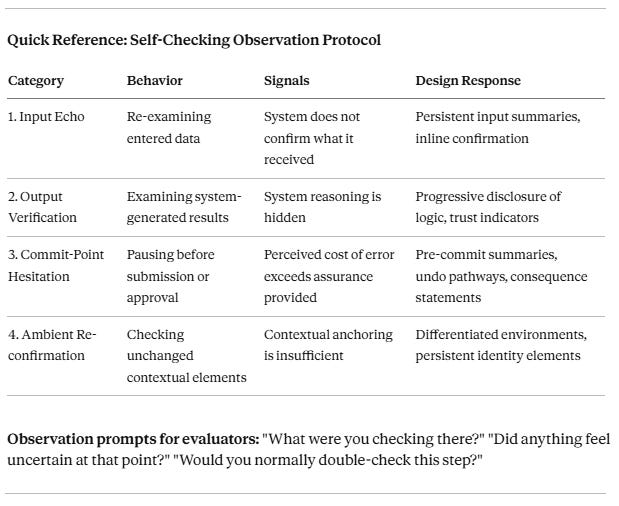
Capturing self-checking requires more than noting that it happened. Evaluators need a structured way to classify what they observe, assess its severity, and connect it to design response. The following framework organizes self-checking behaviors into four categories based on what the practitioner is reviewing and why.
1. Input Echo Checking. The practitioner re-examines data they entered to confirm it was captured correctly. This includes rereading form fields after entry, toggling between input and confirmation screens, or scrolling back to previously completed steps. Input echo checking signals that the system does not adequately confirm what it received. The fix is typically straightforward: persistent input summaries, inline confirmation, or edit-in-place visibility.
2. Output Verification. The practitioner examines system-generated results to determine whether the output reflects their intent. This is common in systems that calculate, summarize, or recommend. The practitioner knows what they asked for but cannot determine whether the system interpreted the request correctly. Output verification signals that the system’s reasoning is hidden. Fixes involve progressive disclosure of logic, trust indicators, or traceable input-to-output mappings.
3. Commit-Point Hesitation. The practitioner pauses at the moment of submission, approval, or irreversible action. They may reread a summary screen, hover over a submit button, or navigate backward one final time before proceeding. Commit-point hesitation signals that the perceived cost of error exceeds the assurance the system has provided. Fixes include clear undo pathways, pre-commit summaries that highlight consequential fields, and explicit confirmation of what will happen next.
4. Ambient Re-confirmation. The practitioner periodically checks elements of the interface that have not changed, such as a patient banner, a file name, or a project identifier. This behavior signals concern about context rather than content: the practitioner is confirming they are still working on the right record in the right place. Ambient re-confirmation is especially common in systems that support multiple concurrent records or contexts. Fixes include persistent contextual anchors, differentiated visual environments per context, and clear state indicators.
Not all self-checking is equal. Input echo checking is the mildest form and often the easiest to resolve. Ambient re-confirmation, particularly in safety-critical systems, can indicate serious trust failures that warrant design priority.
Self-Checking in Practice
The Order That Was Already Cleared. Suppose a hospital pharmacy implements an automated order review system that cross-references prescriptions against patient records, formulary data, and interaction databases. The system flags potential conflicts and clears orders that meet safety thresholds. Post-deployment observation reveals that pharmacists routinely re-examine cleared orders manually, spending an average of fifteen additional seconds per order reviewing information the system has already checked. Standard metrics show no increase in error rates and only modest increases in processing time. A self-checking-aware evaluation would classify this as output verification (Category 2) and investigate whether the system provides sufficient transparency about what it checked and why the order was cleared. The pharmacists are not doubting the system’s accuracy. They are covering for its opacity.
The Approver Who Clicked Through. Consider an expense management platform that auto-categorizes submitted expenses using transaction metadata. Approving managers are shown a summary with category assignments already applied. Observation reveals that managers frequently click into individual line items to review categories, even when the summary view provides all necessary information. Task completion is unaffected, but managers report in follow-up interviews that they “just want to make sure it got it right.” This is a blend of output verification and commit-point hesitation (Categories 2 and 3). The system’s auto-categorization removed a step the managers previously performed manually, but it did not replace the certainty that manual categorization provided. Showing the basis for each categorization decision, even briefly, would address the underlying signal.
The Clinician Who Watched the Banner. Imagine a clinician working in an electronic health record system that supports rapid switching between patient charts. Observation during usability evaluation reveals that the clinician checks the patient name banner after nearly every navigation action, even when the system has not changed contexts. The pattern is most pronounced when the clinician returns from a brief interruption or switches between tasks within the same chart. This is ambient re-confirmation (Category 4) and signals that the system’s contextual anchoring is insufficient for the cognitive demands of multi-patient workflows. Differentiated color schemes per patient, persistent identity elements, and interruption-recovery cues would reduce this form of self-checking.
How to Observe Self-Checking Intentionally
Capturing self-checking requires deliberate attention during evaluation sessions. It will not surface in task-completion data or standard think-aloud protocols unless evaluators are specifically watching for it.
Watch for repeated scanning of previously viewed information, backward navigation after apparent task success, pauses that occur at decision points rather than confusion points, and any moment where the practitioner appears to be confirming rather than progressing. These actions should be noted explicitly, timestamped, and classified using the framework above.
Follow-up questions during or after sessions can clarify intent. Useful prompts include: “What were you checking there?” “Did anything feel uncertain at that point?” “Would you normally double-check this step, or was something about the system prompting that?” Practitioners often surface concerns only when asked directly, and their explanations frequently reveal trust gaps that observation alone cannot fully diagnose.
Treating self-checking as data, rather than incidental behavior, changes how findings are framed. A report that notes “users successfully completed all tasks with no errors” reads very differently from one that adds “however, practitioners engaged in repeated review behaviors at three critical decision points, suggesting that task success required additional cognitive effort the system did not support.”
Designing to Reduce Unnecessary Self-Checking
Reducing self-checking does not mean encouraging blind trust. It means designing systems that help practitioners understand when review is necessary and when it is not. Several design patterns address this directly.
Input echo and persistent summaries. When practitioners enter data that will drive downstream decisions, the system should confirm what it received in the practitioner’s terms, not just the system’s internal representation. A persistent summary that reflects the practitioner’s input, visible at decision points, reduces input echo checking.
Transparent reasoning. When systems automate decisions, even partial transparency about the basis for those decisions reduces output verification. This does not require full algorithmic explanation. A brief statement of the factors considered, such as “Cleared: no interactions found with current medications (checked 4 active prescriptions),” is often sufficient.
Proportional commit-point support. The level of confirmation support at submission points should match the consequences of the action. Low-stakes actions need minimal confirmation. High-stakes or irreversible actions benefit from pre-commit summaries that highlight consequential fields, clear statements of what will happen next, and accessible undo or correction pathways.
Contextual anchoring. In systems that support multiple concurrent records, persistent and visually differentiated contextual indicators reduce ambient re-confirmation. Color-coding, prominent identity banners, and context-change alerts help practitioners maintain orientation without manual checking.
The goal is to align practitioner effort with actual risk, not to eliminate review entirely, but to ensure that the system supports trust where it can so that practitioners reserve their checking for moments that genuinely warrant it.
Boundary Conditions: When Self-Checking Is Not a Usability Signal
Not all self-checking indicates a design problem. In certain contexts, review behavior is appropriate and even expected.
Regulatory environments may require documented human verification regardless of system assurance. Training scenarios often involve deliberate checking as a learning behavior. Genuinely novel or ambiguous situations may warrant review even in well-designed systems. And individual differences in baseline review tendency vary across practitioners and should be accounted for in evaluation design rather than attributed entirely to the interface.
The evaluator’s task is to distinguish between self-checking that arises from the system’s failure to support trust and self-checking that arises from the domain’s legitimate demands. The framework above helps make that distinction by linking observed behavior to specific system characteristics rather than treating all checking as equivalent.
Practical Takeaway
The most important usability signals are not always failures or errors. They are often subtle patterns that indicate where practitioners are doing extra cognitive work to cover for system opacity.
Self-checking deserves to be written down. It reveals where systems technically work but fail to support trust. Ignoring it leads to designs that appear usable while quietly taxing practitioners in ways that metrics never surface and reports never capture.
Usability work that documents self-checking moves closer to the real experience of work: not just what practitioners did, but what they felt they had to review before trusting it was done.
[^1]: John D. Lee and Katrina A. See, “Trust in Automation: Designing for Appropriate Reliance,” Human Factors 46, no. 1 (2004): 50–80.
[^2]: Raja Parasuraman and Victor Riley, “Humans and Automation: Use, Misuse, Disuse, Abuse,” Human Factors 39, no. 2 (1997): 230–253.