



The views expressed are my own and do not represent any organization I am affiliated with.
The Session That Changes How You Think About Usability Testing
Consider a pilot usability study for a clinical decision support tool with adaptive recommendations. By every traditional metric, the study is a success. Task completion rates exceed 90 percent. Time-on-task is well within acceptable bounds. Error rates are low. The summary statistics suggest a well-designed system ready for deployment.
But the session recordings tell a different story. Participants are completing tasks while narrating their uncertainty. “I think this is right, but I’m not sure why it changed.” One clinician finishes a task in under two minutes, then spends another four minutes cross-checking the output against a reference she keeps open in another tab. She never mentions this behavior in the post-task interview. It has become automatic, invisible even to her.
Another participant completes every task successfully but tells the moderator afterward that she wouldn’t trust the system in practice. When pressed, she explains: “It gave me different suggestions for the same patient profile yesterday. I don’t know what changed.” She is describing system adaptation, but she experiences it as unreliability.
A third participant, one of the fastest performers, has developed a habit of rephrasing every query twice to “see if it gives me the same answer.” His efficiency metrics look excellent. His trust in the system is nonexistent.
The metrics say the system works. The behavior says something else entirely.
This scenario is hypothetical, but the pattern is not. Evaluators who work with adaptive systems encounter these disconnects routinely. Traditional usability metrics report success while observed behavior signals doubt, distrust, and workaround. The question is what to do about it.
The Traditional Usability Testing Model
Classic usability testing focuses on a familiar set of outcomes. Can users complete tasks successfully? How long does it take? Where do errors occur? How easily can users recover? These measures remain useful because they capture observable breakdowns in interaction.
Most usability studies are also intentionally bounded. Sessions are short. Tasks are predefined. Participants typically encounter the system in a relatively controlled state. This approach is efficient and appropriate when system behavior is fixed.
Within that context, usability testing excels at identifying interface-level issues and workflow inefficiencies. The method has decades of validation behind it. Nothing I’m about to say should be read as a rejection of that foundation.
Why Adaptive Systems Break the Model
Adaptive systems introduce variability that traditional testing is not structured to observe. Two users may complete the same task using identical inputs and receive different outputs. A single user may receive different results across sessions without any visible explanation. A system may appear to improve performance while simultaneously increasing cognitive burden or mistrust.
From a testing standpoint, this creates ambiguity. Task success remains measurable, but it no longer tells the full story. A participant may complete a task quickly while expressing hesitation, double-checking results, or deferring decisions despite apparent success.
These behaviors are not captured by time-on-task or completion rates, yet they are critical indicators of usability risk. A system that produces correct outputs but erodes user confidence is not, in any meaningful sense, usable.
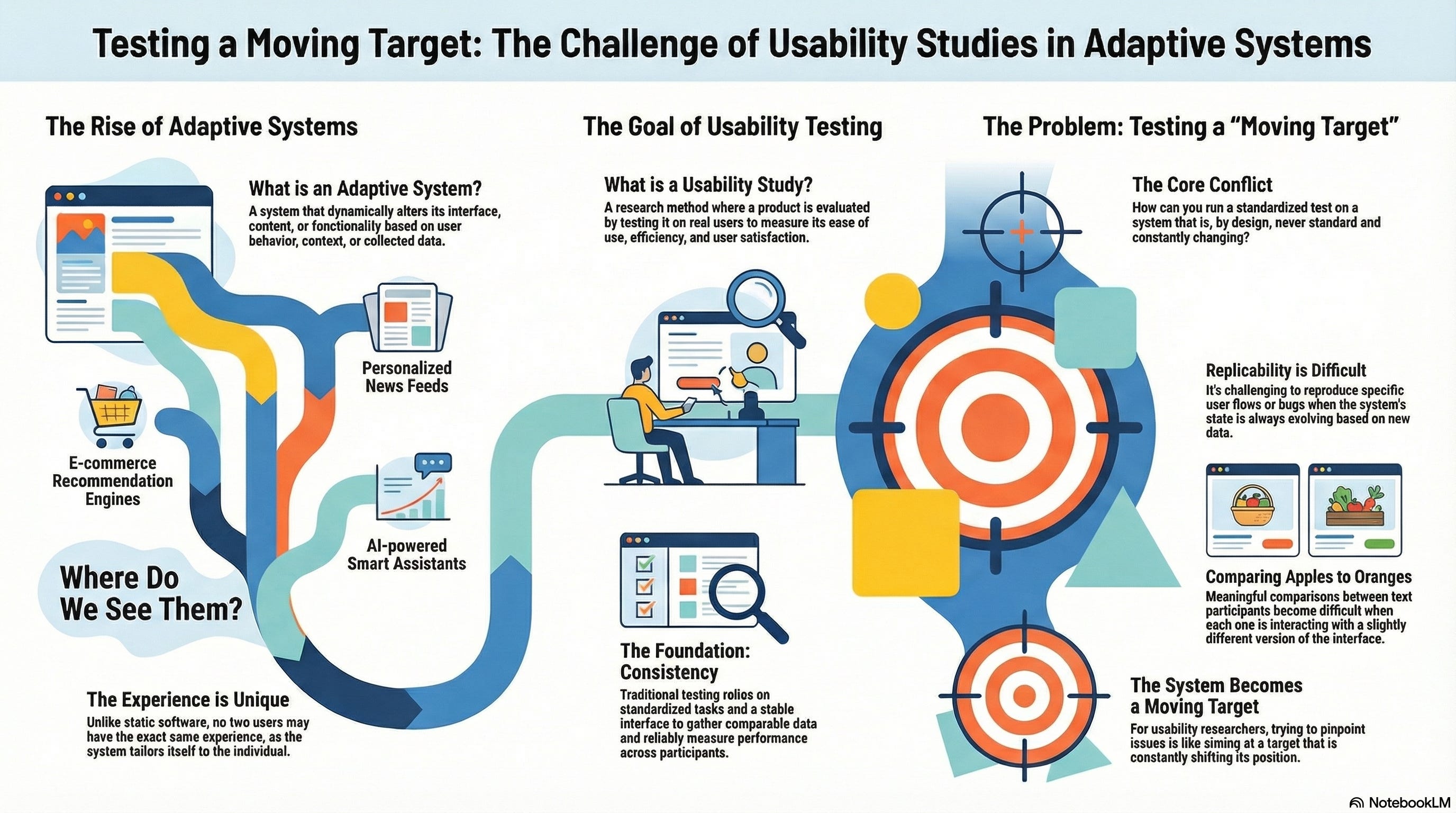
The challenge is not that our methods have failed. The challenge is that the object of study has changed in ways our methods were not designed to detect.
What Still Matters
Despite these challenges, the fundamentals of usability testing remain relevant. Observation is still the most powerful tool available to usability specialists. Watching how users reason about system outputs, when they pause, and when they seek confirmation, provides insight that no automated metric can replace.
Error recovery also remains essential. Users still need ways to revise inputs, undo actions, and correct outcomes. When systems behave adaptively, the ability to recover from subtle or inferential errors becomes even more important. A user who cannot understand why a system produced a particular output will struggle to correct it.
Traditional testing does not become obsolete. It becomes incomplete if used alone.
What Needs Expansion
To evaluate adaptive systems effectively, usability testing must expand in scope rather than reinvent itself. Three areas deserve particular attention.
Longitudinal testing becomes more important. Observing users across multiple sessions reveals expectation drift, trust calibration, and behavioral adaptation that single-session studies miss.
I worked on a study of an AI-assisted documentation tool, with initial sessions showing high satisfaction and efficient task completion. Participants praised the system’s suggestions. They accepted recommendations readily. The first-session data looked like a product launch success story.
By the third session, the picture had changed. Several participants had developed workarounds: copying outputs to a separate document for manual review, maintaining parallel notes, or selectively ignoring certain recommendation types. One user had created a personal checklist of “things the system gets wrong” that she consulted before accepting any suggestion. Another had stopped using the auto-complete feature entirely, preferring to type everything manually despite the time cost.
None of these adaptations appeared in session one. They emerged only through repeated observation. And critically, none of them would have surfaced in post-study satisfaction surveys. When asked, participants rated the system positively. They had simply learned to work around its limitations rather than confront them.
Repeated exposure testing allows evaluators to see how mental models evolve and where they break down. A user’s first encounter with an adaptive system is rarely representative of their eventual relationship with it. The system they meet on day one is not the system they’ll be living with on day thirty.
Prompt or input variation testing helps surface system sensitivity. Small changes in phrasing, order, or context can produce disproportionately different outcomes. Understanding this variability is critical for assessing usability in inferential systems.
In one evaluation of a natural language interface for data queries, we discovered that reordering clauses in a request (”show me sales by region for Q3” versus “for Q3, show me sales by region”) produced meaningfully different outputs. The first phrasing returned a table grouped by region with Q3 totals. The second returned a time series for Q3 broken down by region. Both were arguably correct interpretations. Neither was what the user expected when they saw the alternative.
Users had no way to predict this sensitivity. They experienced it as inconsistency, which eroded their confidence even when outputs were technically correct. One participant summarized the problem precisely: “I never know if I’m asking wrong or if it’s just being weird.”
We’ve since incorporated systematic variation into our test protocols. For each core task, we develop five to seven phrasings that preserve user intent while varying surface structure. We then compare outputs and, more importantly, observe participant reactions when outputs diverge. The surprise, confusion, or frustration that accompanies unexpected variation is itself usability data.
Designing test scenarios that systematically vary inputs, while holding user intent constant, reveals fragility that fixed-task protocols miss.
Trust calibration assessment also becomes necessary. Evaluators should not only observe whether users trust the system, but also whether that trust is appropriate. Overreliance and underreliance are both usability failures, and traditional metrics detect neither.
During a study of an automated triage recommendation system, we observed the full spectrum of miscalibration. Some participants accepted every recommendation without verification, even when the system flagged low confidence. They had learned that checking took time, and the system was “usually right.” When we reviewed their sessions against ground truth, we found they had accepted several incorrect recommendations without noticing.
Other participants rejected high-confidence recommendations because of a single earlier error. One user explained, “It was wrong about the chest pain case, so now I double-check everything.” Her caution was understandable but disproportionate. She was spending cognitive resources verifying outputs the system handled reliably while potentially missing the edge cases that actually warranted scrutiny.
Neither response was appropriate to the system’s actual reliability profile. Both represented calibration failures that traditional task completion metrics would never have surfaced. The overreliant users completed tasks quickly and successfully by the numbers. The underreliant users completed tasks successfully but slowly, which we might have attributed to interface friction rather than trust breakdown.
Calibration assessment requires structured observation and targeted interview questions. We now routinely ask participants to predict system accuracy before seeing outputs, rate their confidence after seeing outputs, and explain their verification decisions. The gaps between prediction, confidence, and behavior reveal where the human-system relationship has gone wrong.
New Metrics Worth Tracking
Adaptive systems require additional measures that complement traditional metrics. These are not replacements for task success or efficiency. They contextualize those measures by revealing what users are actually experiencing.
Cognitive interruption cost captures how often users pause to reassess, verify, or seek reassurance during a task. In practice, this appears as mid-task hesitation, re-reading of outputs, or verbal expressions of uncertainty (”Wait, is that right?”). High interruption cost suggests the system is generating doubt even when it produces correct results.
User correction frequency reveals whether systems invite meaningful correction or silently persist in error. Track how often users attempt to modify, override, or redo system outputs. Low correction frequency in a system that makes errors suggests users have given up on correcting it, not that the system requires no correction.
Trust withdrawal behaviors provide early signals of usability breakdown. These include cross-checking outputs against external sources, avoiding system recommendations in favor of manual alternatives, and verbal disclaimers (”I’ll just do this myself”). When users begin routing around the system, something has failed, regardless of what task completion rates suggest.
Implementation Guidance
Expanding usability testing does not require doubling study budgets or abandoning established protocols. Many of these insights can be gathered through modest extensions to existing methods. The goal is integration, not replacement.
For longitudinal testing: Design studies with two to three sessions per participant, spaced one to two weeks apart. Use the same core tasks across sessions but observe how approach and confidence change. The first session establishes baseline behavior. The second reveals early adaptation. The third surfaces stable workarounds and settled trust levels.
Budget an additional 30 minutes per participant for follow-up interviews that probe mental model evolution. Ask what’s changed since last session. Ask what they’ve learned about the system. Ask what they do differently now. The incremental cost is modest; the insight gained is substantial.
If full longitudinal protocols aren’t feasible, consider diary studies as a lightweight alternative. Ask participants to log moments of surprise, frustration, or uncertainty between sessions. These logs provide a window into adaptation without requiring direct observation.
For input variation testing: Build scenario matrices that hold user intent constant while varying surface-level phrasing, order, or context. Five to seven variations per core task is typically sufficient to surface sensitivity without overwhelming the protocol.
Structure variation systematically. Change one element at a time when possible: word choice, then clause order, then framing context. This allows you to isolate which variations matter and which the system handles gracefully. Analyze outputs for consistency, and observe participant reactions when outputs diverge unexpectedly. The surprise, confusion, or frustration that accompanies unexpected variation is itself usability data, often more revealing than the outputs themselves.
For trust calibration: Embed structured prompts in your post-task interviews. Ask participants to rate their confidence in each output and explain their reasoning. Ask whether they would verify this output in practice, and why or why not. Compare stated confidence to actual system accuracy when that data is available. Flag cases where confidence and accuracy diverge in either direction.
Consider adding a “confidence prediction” task: before revealing system output, ask participants how confident they expect to be in the result. The gap between expected and actual confidence reveals assumptions about system reliability that may not be accurate.
For new metrics: Train observers to note hesitation, verification behaviors, and trust withdrawal using a simple coding scheme. Even a binary present/absent notation for each behavior provides useful signal. More granular coding (frequency, duration, intensity) adds richness but requires more training and may not be necessary for initial assessment.
Aggregate behavioral observations across participants to identify patterns. If six of eight participants cross-check outputs against external sources, you’ve identified a systemic trust issue regardless of what satisfaction surveys report.
The key is recognizing that adaptive systems are not static artifacts. They are evolving interaction partners. Testing them as if they were fixed interfaces risks missing the very behaviors that most affect user confidence and effectiveness.
Risks and Limitations
This expanded approach is not appropriate for every evaluation. Fixed-behavior systems with deterministic outputs do not require longitudinal observation or input variation testing. Adding these methods to studies of stable interfaces wastes resources and delays actionable findings.
Longitudinal testing also introduces participant fatigue and attrition. Not every study can sustain multi-session protocols. When timelines are compressed or participant pools are limited, focus on trust calibration assessment and structured observation of verification behaviors within single sessions.
Finally, the new metrics proposed here are observational, not standardized. They require trained evaluators and consistent coding. Organizations adopting these methods should expect an initial calibration period as teams develop shared definitions and observation practices.
Practical Takeaway
Usability testing still works, but it must adapt to systems that adapt. When system behavior changes over time, across users, or in response to context, usability studies must account for more than immediate task performance.
The goal remains the same: to understand how people experience and rely on systems. What changes is the recognition that usability is no longer revealed in a single interaction. It emerges across patterns of use, correction, and trust over time.
Testing a moving target requires expanding what we observe, not abandoning the methods that brought us this far.
Quick Reference: Usability Testing for Adaptive Systems
Traditional Metric Expanded Metric What It Reveals Task completion rate Completion + verification behavior Whether success masks uncertainty Time-on-task Time-on-task + cognitive interruption cost Whether efficiency masks doubt Error rate Error rate + correction frequency Whether users can/will fix problems Satisfaction rating Satisfaction + trust calibration Whether confidence matches reality
Checklist for Adaptive System Studies:
Plan for multi-session observation when feasible
Build input variation into test scenarios
Train observers to note verification and trust withdrawal behaviors
Include trust calibration prompts in post-task interviews
Compare stated confidence to actual system accuracy
Document workarounds and routing-around behaviors
Report traditional metrics with behavioral context