The views expressed are my own and do not represent any organization I am affiliated with.
The Scenario That Repeats Itself
Consider a common scenario. A healthcare organization builds an internal knowledge base for clinical protocols. The information architecture is solid by traditional standards. Content is logically organized. Labels are clear. Users report high satisfaction in findability studies. Tree tests show strong performance.
Then the organization layers an AI assistant on top. Clinicians can now ask questions and receive synthesized answers drawn from the knowledge base. Within weeks, problems emerge. The assistant conflates protocols that should remain distinct. It surfaces outdated guidance alongside current standards. It summarizes content in ways that strip essential context.
The knowledge base hasn’t changed. The content is still accurate. But the system built on top of it behaves unpredictably, and users begin losing trust in both the assistant and the underlying information.
This is not an AI problem. It is an information architecture problem. The IA was designed for human navigation. It was never designed to be interpreted by a machine that reasons over structure.
What Information Architecture Traditionally Solved
Classic information architecture focuses on three primary concerns: organization, labeling, and findability. Content is grouped in ways that align with user expectations. Labels are chosen to be meaningful, concise, and recognizable. Navigation structures support efficient movement and reduce cognitive load.
When these elements work well, users form accurate mental models of the system. They know where information lives, how to retrieve it, and how to interpret what they find. IA failures, by contrast, manifest as disorientation, search frustration, and repeated backtracking.
This model served us well for decades. It assumes that humans are the primary interpreters of structure. That assumption held through most of the history of digital information systems.
It no longer does.
The New Reader Enters the System
In AI-mediated systems, content is summarized, classified, embedded in vector spaces, retrieved by semantic similarity, and recombined algorithmically. Labels and organization are no longer just navigational aids. They become signals that influence how systems reason about information.
A category name can affect how content is ranked. Metadata can determine whether information is surfaced at all. Structural ambiguity that humans resolve through context may be interpreted literally by machines, leading to unexpected downstream outcomes.
Consider how a human navigates ambiguity. A category labeled “Patient Safety” might contain incident reports, prevention protocols, and training materials. A human user understands these are related but distinct document types. They read context, scan headings, and select appropriately.
A retrieval system operating on the same organization may not make those distinctions. When asked about “patient safety protocols,” it might return incident reports. When asked to summarize training requirements, it might blend content from all three document types. The ambiguity that humans resolve effortlessly becomes a source of system error.
Information architecture now participates directly in system behavior.
Where Traditional IA Quietly Breaks
Many IA practices that work well for humans introduce risk when machines become secondary readers. The failures are often invisible during design reviews because our evaluation methods assume a single audience.
Ambiguous labels that rely on shared context. A category called “Resources” makes sense to humans who understand organizational conventions. To a machine, “Resources” is semantically empty. It could contain anything. When an AI system needs to classify new content or retrieve existing material, ambiguous labels provide no useful signal.
Overloaded categories that collapse meaningful distinctions. Putting policies, procedures, and guidelines into a single “Documentation” category works well for human browsing behavior. But if a system needs to determine whether something is mandatory (policy) versus recommended (guideline), that distinction is invisible in the organization.
Implicit relationships that users infer but machines miss. Humans understand that a document in the “Onboarding” section relates to the “HR Policies” section even without explicit links. Machines operating solely on taxonomy see two disconnected information spaces. Cross-references that seem obvious to human readers may never be recognized algorithmically.
Temporal ambiguity in versioning. A knowledge base might contain current and archived content, distinguished only by folder location or subtle naming conventions. Humans learn to check dates and context. A retrieval system may surface outdated content with complete confidence because the organization provides no machine-readable signal about currency.
These failures rarely appear in traditional IA evaluations. Navigation tests pass. Findability metrics look acceptable. But downstream, users encounter recommendations, summaries, or automated decisions that feel wrong, even though the underlying content is correct.
The problem is not poor IA by human standards. It is IA that was never designed to be read by more than one kind of reader.
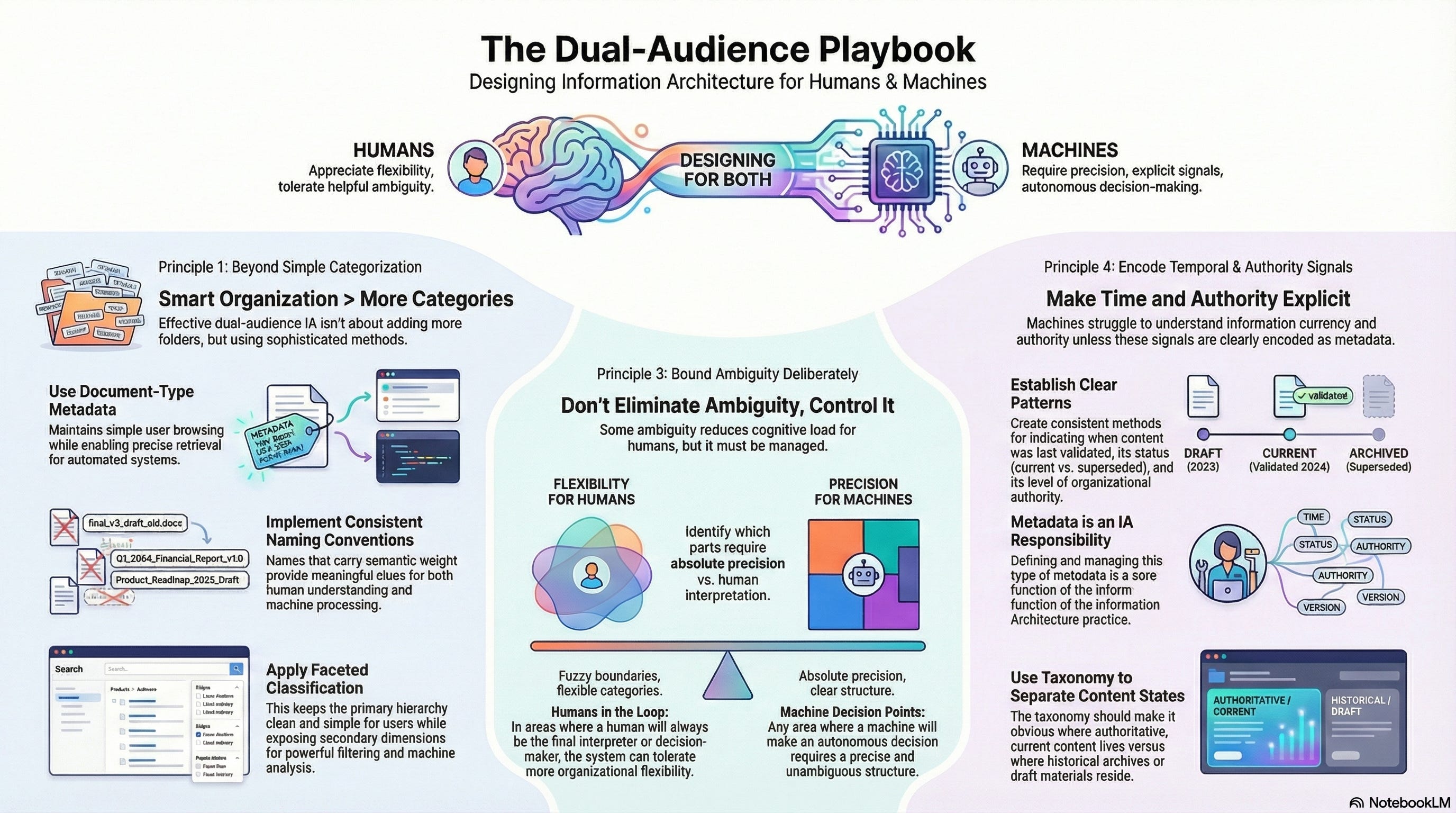
Five Principles for Dual-Audience Information Architecture
Diagnosis is useful, but practitioners need methods. Extending IA practice for machine readers does not require abandoning established approaches. It requires adding a second lens: evaluating organization not only for human comprehension but also for machine readability.
Principle 1: Label for Semantics, Not Just Recognition
Traditional IA favors labels that users recognize. Dual-audience IA requires labels that carry meaning independent of context. “Resources” becomes “Training Materials” or “Reference Documents.” “Stuff to Know” becomes “Required Reading for New Employees.”
The test: Could a system with no knowledge of your organization correctly infer what belongs in this category based on the label alone?
Principle 2: Make Implicit Distinctions Explicit
Where humans infer distinctions from context, machines need explicit signals. If your “Documentation” category contains policies, procedures, and guidelines, consider whether those distinctions matter for automated processing. If they do, surface them in structure or metadata.
This does not always mean creating more categories. You might add document-type metadata that preserves browse simplicity while enabling precise retrieval. You might implement consistent naming conventions that carry semantic weight. You might use faceted classification that keeps the primary hierarchy clean while exposing secondary dimensions. The approach varies; the principle remains constant.
Principle 3: Bound Ambiguity Deliberately
Some ambiguity serves human users well. Flexible categories accommodate edge cases. Fuzzy boundaries reduce cognitive load. Dual-audience IA does not eliminate ambiguity; it bounds it deliberately.
Ask: Where in this system will machines make autonomous decisions based on organization? Those areas require precision. Where will humans always remain in the loop? Those areas can tolerate more flexibility.
Principle 4: Encode Temporal and Authority Signals
Machines struggle with information currency and authority unless those signals are explicit. Establish clear patterns for indicating when content was last validated, whether it represents current or superseded guidance, and what level of organizational authority it carries.
This is metadata work, and it belongs in the IA practice. The taxonomy should make clear where authoritative current content lives versus where historical or draft material resides.
Principle 5: Design for Graceful Retrieval Failure
Even well-organized IA will sometimes fail machine reading. Design structures that fail gracefully. When a query matches multiple categories, is there a sensible default? When content boundaries are unclear, does the organization provide signals that prompt the system to surface uncertainty rather than false confidence?
This principle connects IA to AI system design. Information architects should understand how retrieval and generation systems handle ambiguity, and organize content to support appropriate hedging when matches are uncertain.
Patterns in Practice
These principles manifest differently across contexts. The following patterns illustrate common scenarios, not exhaustive coverage.
The Knowledge Base That Became a Retrieval Source
A professional services firm maintains an extensive knowledge base of methodologies, templates, and case examples. The IA works well for consultants browsing by engagement type or industry vertical.
When the firm implements semantic search, problems emerge. A query for “risk assessment methodology” returns templates, completed examples, and theoretical frameworks intermingled. Consultants waste time sorting through results that are all technically relevant but functionally distinct.
The fix involves adding explicit document-type metadata (methodology, template, example, reference) without restructuring the browse hierarchy. Human navigation remains unchanged. Machine retrieval gains the signals needed to filter and rank appropriately.
The Policy Repository With Invisible Versioning
A regulatory affairs team maintains policies across multiple jurisdictions. Current policies live in one folder; superseded versions move to an archive. Humans learn the convention. The AI assistant built for policy questions does not.
Queries about current requirements occasionally surface archived content. The system has no structural signal distinguishing “current” from “historical.” The fix requires explicit metadata for policy status and effective dates, plus retrieval logic that filters by currency unless historical context is specifically requested.
The Taxonomy That Collapsed Under Automation
An e-commerce platform uses a product taxonomy optimized for customer browse behavior. Categories are broad and intuitive: “Kitchen,” “Home Office,” “Outdoor Living.”
When the platform implements automated categorization for new products, the broad categories provide insufficient signal. Products are frequently miscategorized. A “kitchen island” ends up in “Outdoor Living” because the system fixated on “island” without the contextual understanding humans apply automatically.
Here the organization itself needed adjustment, not just metadata. The team enriched category definitions with explicit inclusion/exclusion criteria. They added secondary attributes that support automated classification. They implemented confidence thresholds that flag uncertain assignments for human review. The browse experience remained simple; the underlying structure gained the precision machines required.
Implementation Guidance
Integrating dual-audience thinking into IA practice requires both evaluation methods and collaborative workflows.
Audit Existing Structures
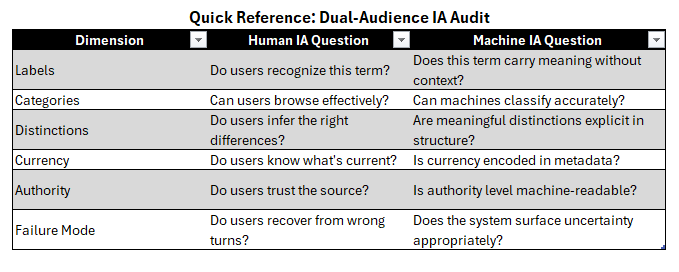
For any IA that will feed automated systems, conduct a dual-audience audit. Review labels for semantic independence. Identify categories that collapse meaningful distinctions. Map where machines will act on organization autonomously versus where humans mediate.
A simple audit matrix helps: list each major structural element, assess human usability (likely already strong), then assess machine readability. Where gaps exist, prioritize based on downstream impact.
Engage Engineering Early
Information architects should understand how their structures will be consumed. What retrieval methods will operate on the taxonomy? What classification systems will use the labels? How does the AI layer handle ambiguity?
This means asking questions and understanding constraints. A thirty-minute conversation with the team building the retrieval layer will surface issues that months of traditional IA work would miss.
Establish Metadata Standards
Many dual-audience problems are solved through metadata rather than restructuring. Document type, currency status, authority level, and confidence indicators all provide machine-readable signals without disrupting human navigation.
Define metadata standards before they are urgently needed. Retrofitting metadata onto large content repositories is expensive. Building it into content governance from the start is manageable.
Test With Both Audiences
Usability testing should include both human navigation tests and machine reading tests. For the latter, work with engineering to run sample queries against the taxonomy and evaluate whether results match expectations.
Where results diverge from intent, diagnose whether the problem is IA organization, retrieval logic, or both. Often it is both, and the fix requires coordination.
Risks and Limitations
Dual-audience IA is not universally applicable. Over-structuring content for machine consumption can harm human usability. Excessive metadata burdens content creators. Rigid taxonomies reduce flexibility for edge cases.
The goal is not maximum machine readability. It is appropriate readability, calibrated to how machines will actually use the organization. If human review mediates all AI outputs, structural precision matters less. If machines act autonomously based on taxonomy, precision is essential.
Additionally, this framing applies primarily to systems where organization influences behavior. Simple search applications may not warrant the overhead. Complex retrieval, summarization, and reasoning applications almost certainly do.
Information architects must assess their specific context and apply these principles proportionally.
Conclusion
Information architecture no longer serves a single audience. When systems retrieve, summarize, and reason over information, organization becomes an input to inference. Categories shape classification. Labels influence ranking. Boundaries determine what machines include or exclude from their processing.
This shift does not diminish IA’s importance. It expands it. The same skills that have always supported human comprehension now serve a second purpose: enabling reliable machine reading. Clear labeling. Logical organization. Meaningful boundaries. These principles apply to both audiences.
Information architecture becomes a form of behavioral design.
The practitioners who recognize this shift and adapt their methods will shape how AI-mediated systems behave. Those who continue designing for humans alone will find their careful work undermined by systems that read the same taxonomy and reach different conclusions.
The question is no longer whether information can be found. It is whether it can be understood correctly by every reader that touches it.