


The views expressed are my own and do not represent any organization I’m affiliated with.
Personas are often introduced as a way to make users memorable. That is useful, but it is not enough.
A persona that only gives a name, job title, quote, photo, and list of preferences may help a team talk about users more easily. It may even create empathy. But in complex systems, empathy alone does not tell a designer where the system will fail, where training will be needed, where workload will accumulate, or where a decision aid may create new risk.
For human factors, usability, and human systems integration work, personas should do more than represent users. They should help model the operating conditions under which people interact with systems.
That means a persona should not simply answer, Who is this user? It should help answer a more practical question: What does this user need to accomplish, under what constraints, with what consequences if the system does not support the work?
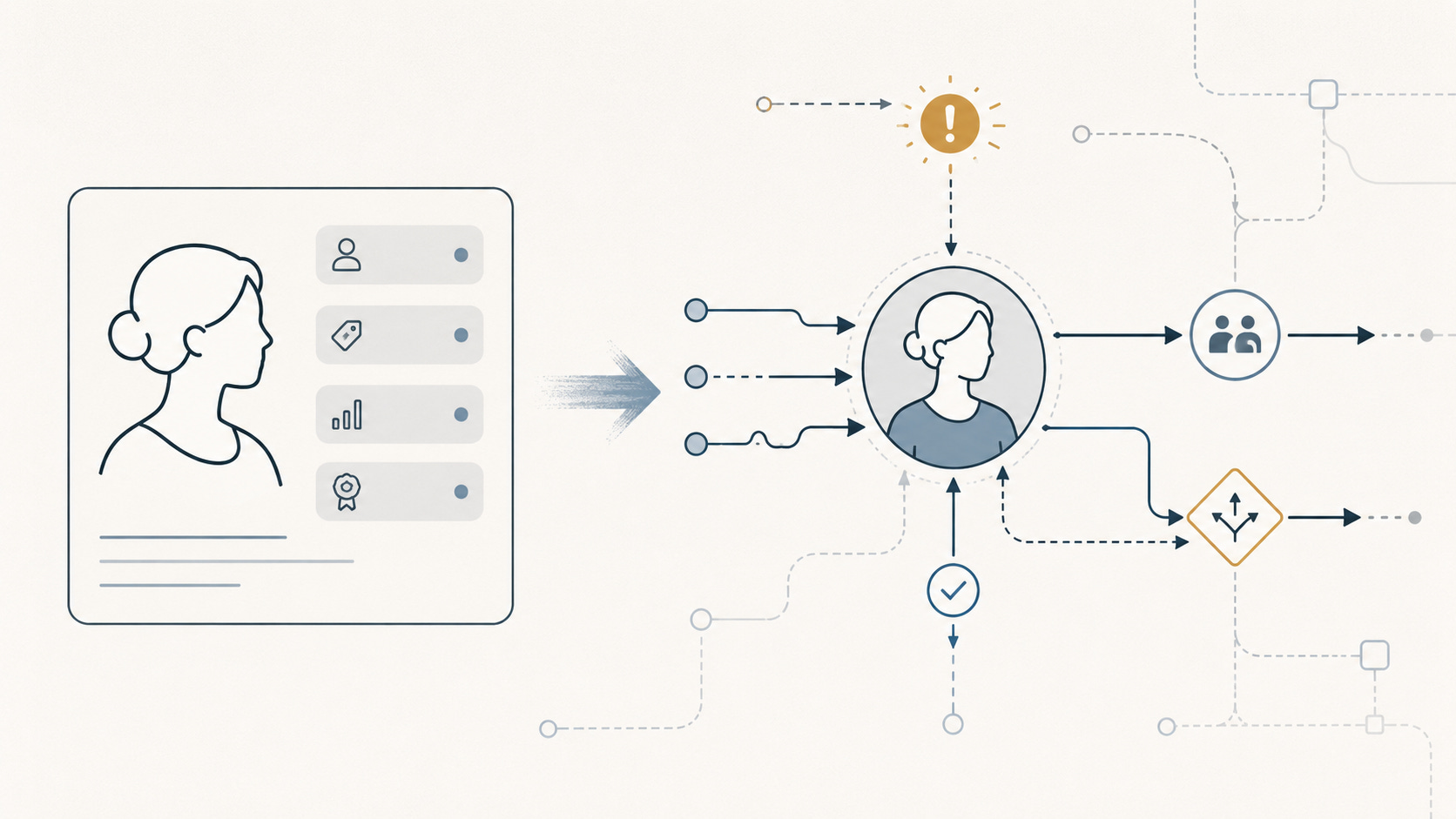
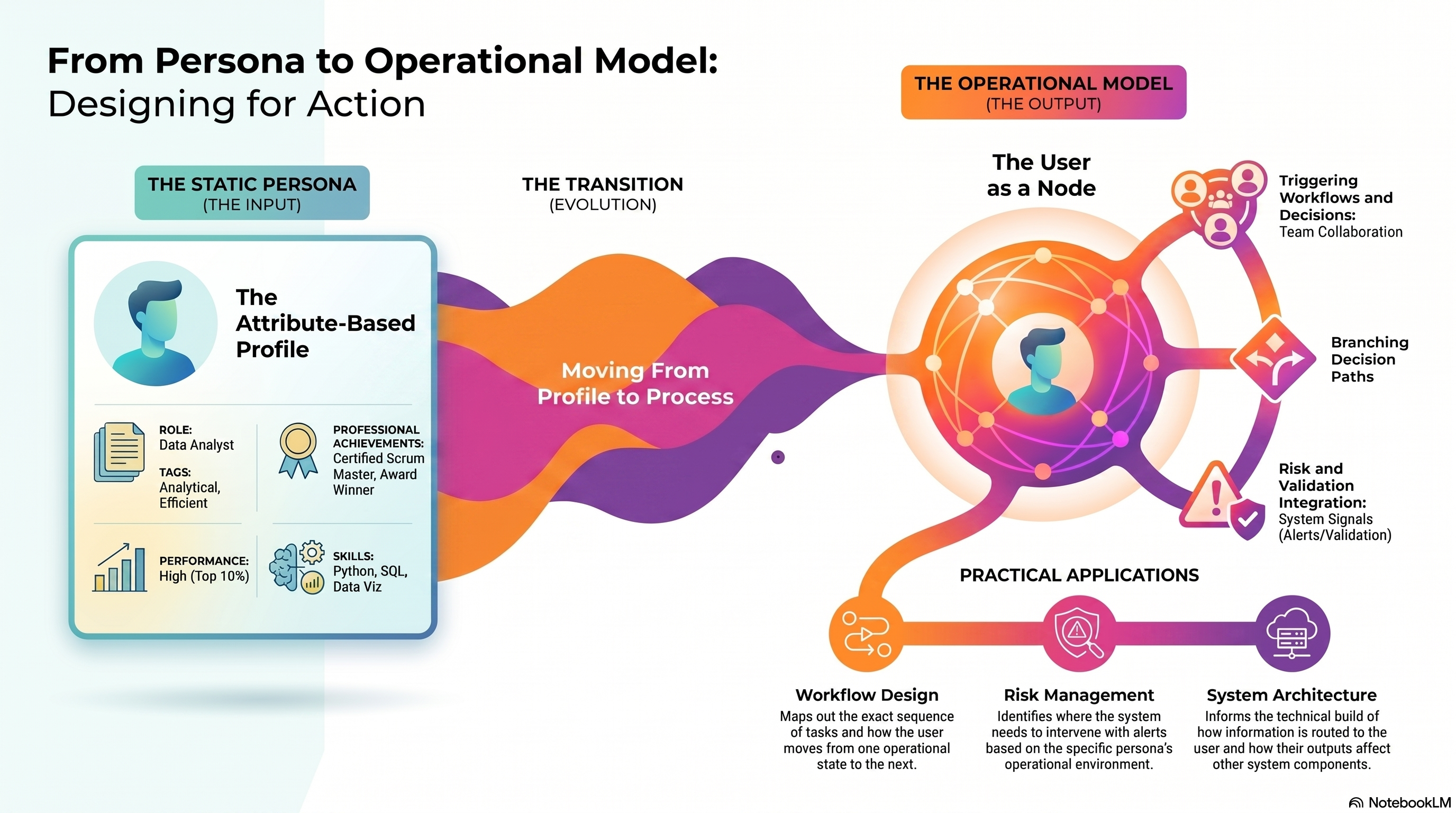
When personas are treated this way, they become more than design communication tools. They become operational models.
The limits of the lightweight persona
The lightweight persona is familiar. It usually includes a fictional name, role, demographic sketch, goals, frustrations, and a short narrative. In product design, this can be helpful because it gives teams a shared reference point. Instead of saying the user, a team can say this is how Denise would experience the workflow.
That shift matters. Abstract users are easy to ignore. Specific users are easier to remember.
The problem is that many personas stop at memorability. They describe the user but do not explain the work. They capture preferences but not constraints. They identify frustrations but not system dependencies. They may state that a user is busy, experienced, or technology hesitant, but they often do not show what that means in a real task environment.
For low-risk consumer products, this may be sufficient. For healthcare, government, defense, enterprise software, and AI-enabled tools, it is usually not.
In these settings, users are not simply consumers making individual choices. They are operators inside larger systems. They work with policies, handoffs, legacy tools, documentation requirements, interruptions, time pressure, professional norms, and accountability structures. Their interaction with a system is shaped by more than preference. It is shaped by the conditions of work.
To be useful, then, a persona must move beyond personality and preference. It must describe the relationship between the person, the task, the environment, and the system.
Personas as models of work
The stronger version begins with context of use. This includes the user’s tasks, environment, tools, constraints, goals, and organizational setting. In human-centered design, context is not background information. It is part of the design problem.
For example, two users may share the same job title and still require different design support. One may work in a quiet office with time to review information carefully. Another may work in a high-interruption environment where decisions are made quickly, documentation is fragmented, and attention is divided across multiple systems.
A demographic persona may treat these users as similar. An operational persona treats them as meaningfully different.
The difference is important because design failures often appear at the boundary between formal workflow and real work. A process map may show the approved sequence of steps. A policy may describe the expected behavior. A training document may explain the correct way to complete a task. But actual work often includes exceptions, local adaptations, delays, incomplete information, and competing demands.
Exposing that gap is the operational persona’s job. It should show what the user is trying to accomplish, what information they need, and where they get it. It should show what they trust, what interrupts them, what tools compete for their attention, and what happens when the system does not fit the workflow.
The point is not added length for its own sake. A persona built this way earns its detail by making the work more legible.
What an operational persona should include
A practical operational persona should include several elements that are often missing from traditional persona templates.
First, it should include the user’s primary tasks. Not broad goals such as provide quality care or manage workload, but concrete activities the system must support. What does the user actually do? What decisions do they make? What information do they enter, retrieve, verify, interpret, or communicate?
Second, it should include workflow position. Is this user at the beginning of a process, the middle, or the end? Do they initiate work, review work, approve work, correct work, or inherit work from others? A user who creates information has different needs from a user who must later interpret it.
Third, it should include constraints. These may include time, staffing, policy, physical environment, competing systems, training variability, documentation burden, and interruptions. Constraints are not side issues. They are often the reason a design succeeds or fails.
Fourth, it should include information dependencies. What does the user need to know before acting? Where does that information come from? Is it structured or unstructured? Is it trusted? Is it current? Is it visible at the right point in the workflow?
Fifth, it should include risk exposure. What happens if this user misunderstands the system, misses a signal, accepts a poor recommendation, enters incomplete data, or cannot recover from an error? In many systems, the consequence of poor usability is not simply dissatisfaction. It may be delay, rework, poor coordination, degraded trust, or operational risk.
Finally, it should include support needs. Does the user need guidance, confirmation, explanation, defaults, alerts, training, job aids, peer review, or better system feedback? A persona that cannot inform support design is probably not detailed enough.
From description to prediction
The value of an operational persona is not only that it describes users. Its value is that it helps teams make better predictions.
A team reviewing a proposed design should be able to use the persona to interrogate that design before a single test session is scheduled. The persona tells them whether the user will understand what the system is asking for, and whether the information the user needs will actually be present at the moment of the request. It tells them whether a new workflow adds documentation burden rather than removing it, and whether an alert will arrive when the user can still act on it. It tells them where an AI-generated recommendation is likely to be trusted too much, trusted too little, or trusted for the wrong reason. Above all, it tells them where the design is likely to produce a workaround, and whether a given feature helps the user recover from a real error or only prevents the ideal error imagined by the design team.
These questions matter because many usability problems are predictable before formal testing. A well-constructed persona gives the team a way to identify likely friction points earlier, especially when paired with scenarios, journey maps, task analyses, and usability findings.
The goal is not to replace testing. The goal is to improve the quality of design reasoning before testing begins.
A case in point
Consider a hypothetical that composites a familiar pattern in healthcare informatics work. A health system rolls out an AI feature that drafts the summary portion of a clinical note. The project persona is a lightweight one: Dr. Lang, experienced physician, values efficiency, frustrated by documentation time. On that persona, the feature looks like a clear win, because it removes typing and returns minutes to a hurried clinician.
Now rebuild the same user as an operational persona. The primary task is not write a note. It is to produce a record that is accurate enough to support the next clinician’s decision and to withstand later review. The workflow position is consequential: the physician sits in the middle, inheriting structured data from intake and handing a record forward to colleagues and to billing. The binding constraint is interruption, because the note is often finalized between patients, in fragments. The information dependency is that the draft is only as good as the data it summarizes, and the physician cannot always see what the model left out. The risk exposure is that an inaccurate summary, signed under time pressure, propagates downstream as if it were verified.
Read that way, the persona predicts the failure before testing finds it. The design did not add a writing task. It added a verification task, and it placed that task exactly where the user has the least attention to give it. The fix is not a better draft. It is a display that surfaces what the summary is based on, flags low-confidence content, and makes the act of confirmation deliberate rather than reflexive. A demographic persona praising efficiency would never have surfaced that requirement. The operational persona made it visible while the design was still cheap to change.
Why this matters for AI-enabled systems
Operational personas become even more important when systems include AI.
AI tools often change the user’s role. A person who once produced a document may now review a draft. A person who once searched for information may now evaluate a generated summary. A person who once made a decision from raw data may now decide whether to accept, reject, or question a recommendation.
That shift changes cognitive work.
The user may spend less time producing an output, but more time verifying accuracy, identifying missing context, judging confidence, detecting hallucinations, explaining decisions, or managing accountability. The task has not disappeared. It has moved.
Where a traditional persona may say that the user wants efficiency, an operational persona asks what kind of efficiency is safe, where verification burden lands, and what the user must understand to remain meaningfully in control.
For AI systems, the persona should clarify the user’s relationship to the tool. Is the user an operator, reviewer, approver, supervisor, beneficiary, affected party, or downstream recipient of AI-generated output? Each role carries different needs and risks.
A clinician reviewing an AI-generated note, a benefits specialist evaluating a recommendation, a supervisor monitoring automated case routing, and a patient reading a portal summary are not simply different users. They occupy different positions in a human-AI system.
Designing for them requires more than empathy. It requires operational clarity.
Personas should connect to evidence
Personas are most useful when they are grounded in evidence. That evidence may come from interviews, observation, usability testing, workflow analysis, support tickets, training feedback, incident reports, analytics, survey data, or subject matter expert review.
The point is not that every persona must be statistically representative in the same way as a survey sample. Personas are interpretive models. But they should still be traceable to real findings.
Teams should be able to answer a short set of questions about any persona they rely on. What evidence supports it? What user groups or roles does it represent? What assumptions in it are still unvalidated? When was it last reviewed? What systems, workflows, or contexts does it apply to, and what should not be inferred from it?
This is especially important in large organizations where personas can outlive the research that produced them. A persona created for one system, workflow, facility type, or user group may be reused in a setting where it no longer fits.
A persona without provenance becomes folklore.
To guard against that, an operational persona should carry enough metadata to support responsible use. It should have a source history, validation status, date of last review, and known limits. This keeps the persona from becoming a decorative artifact or a permanent stereotype.
Personas should not replace direct user engagement
A good persona helps teams remember what they have learned about users. It does not eliminate the need to keep learning.
This distinction matters. Personas can be misused when teams treat them as substitutes for current research. A persona should focus attention, organize evidence, and help frame design questions. It should not become an excuse to avoid interviews, observation, usability testing, or field validation.
The more complex the system, the more important this becomes. In high-stakes domains, user needs change as policies, technologies, staffing models, and workflows change. A persona that was accurate three years ago may still be useful, but it should not be assumed to be current.
Operational personas should be living artifacts. As the evidence changes, they should be reviewed and refined, and when they no longer fit, retired or replaced.
A practical template shift
The simplest way to improve persona quality is to change the template. Instead of centering the artifact on biography, center it on operational usefulness.
A traditional persona might ask: Who is this person? What are their goals? What frustrates them? What technology do they use?
An operational persona asks a different set. What work must this person accomplish? What conditions shape that work? What information do they need, and what decisions do they make? Which errors or delays are most consequential? What system behaviors help or hinder them, and what support do they need at the point of action? And finally, what assumptions about this user are evidence-based, and what still needs validation?
This shift does not strip the human out of the persona. It makes the persona more honest about how humans actually interact with systems.
Takeaways for practice
A persona should be judged by what it helps a team do. If it only helps the team talk about users, it is useful but limited. If it helps the team anticipate workflow friction, design better support, identify risk, frame usability testing, and evaluate design tradeoffs, it has become an operational model. For human factors and HSI work, that should be the goal.
Personas should not be treated as static portraits. They should be practical representations of people doing work inside systems, connecting user characteristics to tasks, constraints, decisions, information needs, risks, and support requirements.
Used this way, a persona becomes more than a UX artifact. It becomes a bridge between research and design, between field reality and system requirements, and between what teams imagine users do and what users actually have to accomplish.
A good persona does not merely make the user memorable.
It makes the work visible.
So before building another persona, it is worth asking whether the ones already in use can support better design decisions. Can they predict workflow friction? Can they inform usability test scenarios, identify risk, and clarify how AI changes the user’s role? Can they distinguish between the user as imagined and the user as operating inside a real system? If not, the persona may need to mature from a profile into an operational model.
Source basis: Nielsen Norman Group frames personas as a way to make user groups tangible and memorable and treats them as living documents requiring ongoing validation (Taylor Dykes, “Personas Make Users Memorable,” NN/g, October 2025). ISO 9241-210 and NIST human-centered design guidance both treat understanding context of use as a central design activity. Alan Cooper’s goal-directed design work treats personas as tools for understanding needs and prioritizing users. Pruitt and Adlin’s persona lifecycle work emphasizes keeping users in mind throughout product development. Human systems integration guidance frames human considerations as part of the total system, not just the interface.