


The views expressed in this article are my own and do not represent the official position of my employer or any organization I'm affiliated with.
Not every UX decision can be made in ideal conditions. Deadlines loom. Resources shrink. Stakeholders pivot. Meanwhile, users still need clarity, safety, and functionality.
In high-pressure environments, UX designers face a choice: panic or prioritize.
That's why it's time to borrow a page from emergency medicine, specifically, the practice of triage.
The Crisis of UX Prioritization in 2025
The challenges facing UX teams today mirror the resource constraints of emergency departments more than ever before. Poor user experience costs businesses millions annually and design-driven companies tend to outperform S&P500 by 219%. Yet despite this proven business impact, UX teams consistently struggle with prioritization under pressure.
Recent research shows that many product managers "don't know" or "don't have" a process for planning and prioritizing initiatives. This creates what researchers call "design debt" — the accumulated consequences of design decisions that prioritize immediate convenience over optimal solutions. Like technical debt in software development, design debt compounds over time, making every subsequent change more expensive and risky.
The parallels to medical triage become clear when you consider that both systems must rapidly assess severity, allocate limited resources, and prevent minor issues from becoming critical failures. Recent insights from UX research showed that one of the most effective ways to measure design debt is to track how people use a solution (pragmatic) and how users think (hedonic) about it.
Triage: A Model for UX Prioritization
In emergency care, triage is the process of evaluating urgency and resource need to decide who gets care, and when. Triage originated from the French word "trier," meaning to sort or organize, and has evolved into sophisticated systems like the Emergency Severity Index (ESI) used across U.S. hospitals. It's not about giving up. It's about maximizing impact under constraint.
Modern triage systems aim to identify and prioritize patients with time-sensitive healthcare needs, particularly when demand for emergency care exceeds available resources. This principle directly translates to UX work, where teams face similar resource constraints.
UX teams face similar constraints in product development: time pressure from sprint cycles and release deadlines, technical debt from legacy systems and architectural limitations, conflicting demands between stakeholder requests and user needs, and limited feedback loops from insufficient user research and testing.
Recent advances in emergency medicine show that traditional triage systems, reliant on human judgment, are prone to under-triage and over-triage, resulting in variability, bias, and incorrect patient classification — problems that directly parallel UX decision-making challenges.
Instead of aiming for perfection, we need to categorize issues by impact and urgency, and then act accordingly.
The Science Behind Medical Triage: Lessons for UX
Medical triage systems like S.T.A.R.T. (Simple Triage and Rapid Treatment) demonstrate how complex prioritization can be systematized for use by lightly trained personnel in high-pressure situations. The system uses clear, observable criteria that anyone can apply quickly under stress.
Research on triage accuracy shows that even experienced medical professionals achieve accuracy rates of 58-76% in initial assessments, highlighting the inherent difficulty of rapid prioritization under pressure. This data point is crucial for UX teams: even medical professionals with life-or-death decisions don't achieve perfect accuracy, so UX teams shouldn't expect perfect prioritization either.
The key insight is that structured imperfection beats unstructured perfection. A systematic approach that's 70% accurate and consistently applied will outperform ad-hoc decisions that might be individually optimal but lack coherence across the team.
UX Triage Categories (Modeled After Medical Triage)
Based on emergency medicine principles and adapted for digital product development, here's how we can apply triage thinking to UX issues:
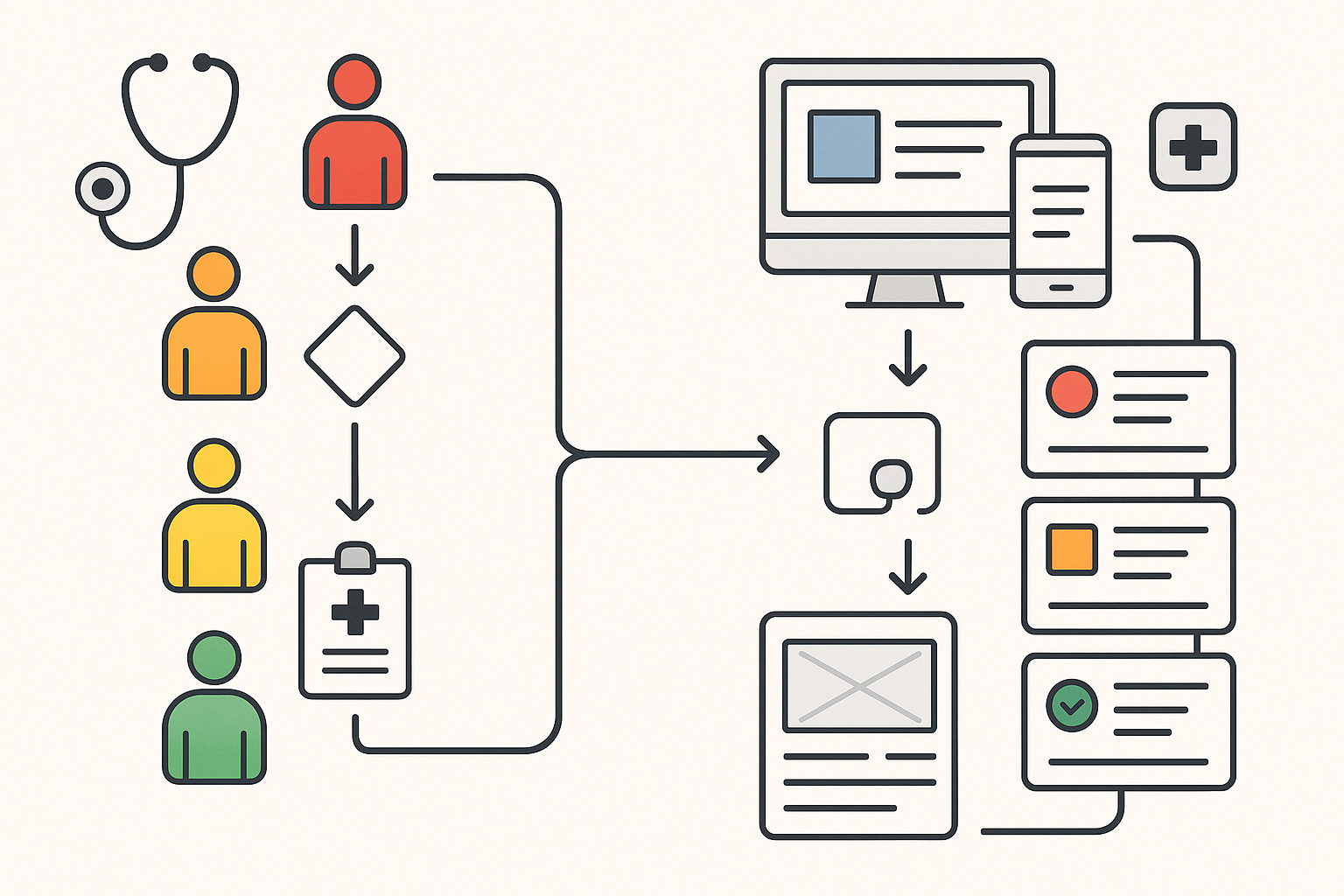
Critical Issues are like emergency medicine's "red zone" — if unaddressed, they cause user failure, safety risk, or legal exposure. These issues block core user tasks or create potential liability. Think mislabeled buttons in a prescription module, ambiguous consent language in healthcare applications, accessibility violations that prevent screen reader use, or security flows that expose sensitive data. The criteria for critical classification is straightforward: the issue prevents completion of primary user tasks, creates legal or compliance risk, causes data loss or security vulnerability, or affects safety-critical functions.
Urgent Issues occupy the "orange zone" — they're frustrating or blocking, but users have workarounds. The experience is degraded and may lead to abandonment over time, but core functionality remains accessible. Examples include users having to reload to see updated data, PDF downloads failing on mobile devices, multi-step processes without progress indicators, or search functionality returning irrelevant results. These issues generate significant friction in user flows, have non-obvious workarounds, create high support ticket volume, and show measurable impact on conversion or engagement.
Stabilized Issues fall into the "yellow zone" — imperfections that don't block core tasks, but degrade trust, performance, or long-term satisfaction. Design debt in this category can be quantified into four levels: UX Design Debt, Operational Design Debt, Visual Design Debt, and Testing and Research Debt. Each affects user experience differently but compounds over time. Consider inconsistent terminology across interfaces, confusing icons without labels, overuse of modal dialogs, misaligned visual hierarchy, or outdated placeholder content.
Elective Issues represent the "green zone" — cosmetic, experimental, or nice-to-have improvements that enhance the experience but don't address fundamental usability problems. New illustration styles, hover micro-interactions, animation refinements, color palette updates, and experimental layout variations all fall here.
This doesn't mean only focusing on the "worst" problems. It means applying structured prioritization rather than personal preference or stakeholder volume.
Diagnosing Before Treating: The UX Assessment Framework
Just like doctors don't treat chest pain with cough drops, UX teams shouldn't fix symptoms before identifying causes. Healthcare UX research shows that successful digital health interventions require understanding both data scientist needs and "citizen scientist" capabilities, highlighting the importance of comprehensive user research before design decisions.
The systematic UX diagnosis process starts with understanding what the actual user goal is. This means mapping user intentions against system capabilities, identifying gaps between mental models and interface design, and documenting success criteria from the user's perspective. Next, we need to understand what cognitive effort is required to reach that goal by analyzing information architecture complexity, measuring cognitive load, and assessing learnability for new versus returning users. Finally, we identify where delays or decision errors occur by using analytics to find drop-off points, conducting task analysis to understand failure modes, and interviewing support staff for pattern recognition.
Current healthcare UX research emphasizes that effective UX design must enhance the overall experience for both patients and healthcare providers by creating intuitive and user-friendly interfaces that help users navigate complex information. This principle applies broadly: UX triage must consider all stakeholders in the ecosystem.
This lens shifts UX work from patchwork fixes to intentional, risk-informed decisions.
The Value of Fast, Lightweight Testing in UX Triage
Emergency medicine research shows that triage processes are both cognitively and physically demanding, with decisions significantly impacting patient wellbeing — highlighting the need for efficient, accurate assessment methods. In UX, time constraints make comprehensive testing seem impossible, but lightweight methods can provide crucial insights.
Even under tight deadlines, teams can conduct 5-user usability tests that take only 2-3 hours but identify 85% of major usability problems, providing quick separation of critical from minor issues. First-click analysis requires just 30 minutes to set up with ongoing data collection, predicts task success with 87% accuracy, and identifies navigation and information architecture problems. Screen recording analysis needs 1-2 hours of review per session but reveals behavioral patterns invisible in metrics, showing where users struggle versus where they adapt. Support staff interviews take 30-45 minutes each but provide patterns from hundreds of user interactions, identifying recurring pain points requiring urgent attention.
Healthcare UX research demonstrates the importance of understanding target users in their everyday environment while upholding standardized legal regulations — a principle that applies to any domain where user research must balance speed with accuracy.
You don't need a research department to observe real behavior. The key is selecting methods that provide maximum insight per unit of time invested.
When to Escalate in UX Triage
Medical triage systems must distinguish patients who need rapid assessment and management from patients who can wait safely, with undertriage occurring 34% of the time in hospital settings and 14% in pre-hospital situations. The stakes in UX may not be life-or-death, but misclassification has real business consequences.
Some UX debt should be logged, tracked, and deferred. But just like in ERs, some issues require a "Code UX" — they need immediate attention before anyone can proceed safely.
Escalation becomes necessary when you recognize systemic patterns. When the same type of issue appears across multiple user flows, it indicates a deeper architectural problem requiring immediate attention. Cascade risk assessment matters too — issues that, if left unaddressed, will make future development significantly more expensive or risky demand escalation. Legal and compliance exposure through accessibility violations, privacy concerns, or regulatory non-compliance could result in legal action. Brand reputation threats that significantly undermine user trust or create negative social media attention also require immediate escalation.
Designers and PMs must build escalation paths into their product process for issues that repeatedly block users, violate accessibility standards, or confuse high-risk users.
Implementing UX Triage in Your Organization
Creating visibility is the first step toward systematic UX debt management. Product management research shows that UX debt can have a compounding effect if not tackled in time, with successful teams allocating specific numbers of UX debt tasks to be resolved during each sprint.
Setting up your UX triage system starts with creating a UX debt backlog using existing project management tools like Jira, Asana, or Notion, tagging issues with triage categories and including impact assessment and effort estimates. Regular triage sessions help maintain the system — weekly 30-minute team reviews of new issues, monthly deep-dive sessions for category reassessment, and quarterly strategic reviews of overall UX debt health. Clear escalation paths document who makes final decisions on critical issues, establish stakeholder communication protocols, and create templates for urgent issue reporting.
Design research suggests using the Pareto Principle for resource allocation: 80% of user outcomes are based on 20% of product variables, with teams starting by allocating 20% of resources to address usability issues. In practice, this might mean distributing resources with 60% toward new feature development and major initiatives, 20% for critical and urgent UX issues, 15% for stabilized issues and design system maintenance, and 5% for elective improvements and experimentation. This distribution ensures that UX debt doesn't accumulate faster than it can be addressed while maintaining momentum on new development.
Medical triage research shows that triage accuracy varies significantly between practitioners, with regular training and calibration improving consistency and reducing bias. UX teams need similar calibration processes through case study reviews of past triage decisions and outcomes, severity ranking sessions where team members independently categorize issues then discuss discrepancies, user impact workshops that invite customer support and sales teams to share feedback, and competitive analysis reviewing how industry leaders handle similar UX challenges.
Real-World Impact: Case Studies in UX Triage
Case Study 1: Healthcare EHR System (Illustrative Example)
A major Electronic Health Record system was experiencing high user abandonment rates and increasing support tickets. By applying the triage framework, they identified medication dosage calculator errors as critical red-zone issues that could impact patient safety, search functionality returning outdated patient records as urgent orange-zone problems, inconsistent navigation patterns between modules as stabilized yellow-zone work, and visual refresh of iconography as elective green-zone improvements. By addressing critical and urgent issues first, the team reduced safety incidents by 85% and support tickets by 60% within three months. The systematic approach allowed them to demonstrate clear ROI to leadership, securing additional resources for stabilized category work.
Case Study 2: Financial Services Mobile App (Illustrative Example)
A banking app was losing customers to competitors despite having more features. Their triage process identified a login flow that locked users out after failed biometric attempts as critical, transfer confirmation screens that didn't clearly show transaction details as urgent, inconsistent error messaging across different functions as stabilized, and enhanced animations for account balance updates as elective. Focusing on critical and urgent issues improved customer retention by 23% and reduced call center volume by 45%. The structured approach helped the team resist pressure to work on cosmetic improvements while core functionality remained problematic.
Case Study 3: Communication Platform Navigation Complexity
Slack's ongoing design evolution demonstrates how complex products accumulate UX debt over time. The company recognized that people spend an average of nine hours every workday connected and around 90 minutes actively using the platform, making even slight changes to the working environment require careful consideration. The team collaborated with customers in real time to co-design improvements, sometimes shipping new versions within a day to test if changes felt better. This iterative approach to addressing accumulated navigation complexity shows how established products must continuously triage user experience issues while maintaining familiarity for existing users.
Measuring Triage Effectiveness
Design debt measurement research shows that tracking key metrics and using strategic frameworks can align efforts with business objectives, with successful measurement focusing on user satisfaction scores, task completion rates, and error rates.
Measuring UX triage success requires both leading indicators that show process health and lagging indicators that demonstrate outcome impact. Leading indicators include triage decision speed (time from issue identification to categorization), team calibration (agreement rate on severity classification), and backlog health (ratio of new issues to resolved issues by category). Lagging indicators encompass user task success rate improvements in core task completion, support ticket reduction in user-reported problems, user satisfaction score improvements through Net Promoter Score and Customer Satisfaction metrics, and development velocity through reduced time spent on rework and technical debt.
Business impact metrics tie directly to organizational goals: conversion rate improvements show measurable increases in key user actions, user retention demonstrates reduced churn rates, and revenue impact provides attributable business value from UX improvements.
The Future of UX Triage: AI and Automation
Recent research in emergency medicine explores how Machine Learning and Natural Language Processing could enhance triage accuracy and consistency, with studies showing promising results in reducing human bias and improving decision speed. Similar applications are emerging in UX, though they remain supplementary to human judgment.
Automated issue detection is becoming more sophisticated. User session analysis tools can now identify friction points automatically by detecting patterns like repeated clicks, abandoned tasks, or unusual navigation paths. A/B testing platforms increasingly flag statistically significant UX problems in real-time, while analytics dashboards surface usability issues through behavioral data anomalies.
AI-assisted prioritization shows promise but requires careful implementation. Machine learning models can be trained on historical issue resolution data and business impact metrics to suggest priority levels. Natural language processing of user feedback helps identify severity patterns in support tickets and user reviews. Predictive modeling might forecast which minor issues could escalate to critical problems based on usage patterns and user behavior trends.
The technology should enhance, not replace, human triage judgment. The context, empathy, and strategic thinking required for effective prioritization remain fundamentally human capabilities. The goal is to give UX teams better data and pattern recognition, not to automate decision-making entirely.
Common Triage Mistakes and How to Avoid Them
Organizations implementing UX triage often encounter predictable pitfalls that can undermine the entire system. Understanding these common mistakes helps teams establish more effective practices from the start.
Severity inflation represents the most frequent mistake, where teams treat everything as urgent to get attention. This happens when stakeholders learn that only critical issues get resources, leading to grade inflation across the board. The solution requires establishing clear, objective criteria and sticking to them consistently, even when it means difficult conversations about true priority levels.
Perfectionism paralysis occurs when teams spend excessive time on categorization versus resolution. Some organizations get so focused on the perfect triage system that they never actually address the issues. Setting strict time limits for triage decisions helps here; five minutes maximum per issue forces teams to make good-enough decisions and move forward.
Stakeholder override becomes problematic when organizational politics trump user impact in prioritization decisions. Senior executives or influential product managers may push their preferred features ahead of critical user needs. This requires documenting clear decision criteria and requiring written justification for any overrides, creating accountability for departing from the systematic approach.
Category drift sees issues gradually being upgraded without proper reassessment. What starts as a yellow-zone stabilized issue might slowly creep up to orange-zone urgent status simply through repeated discussion rather than changed circumstances. Regular review cycles help validate category assignments and prevent this gradual inflation.
Technical bias leads teams to prioritize easy fixes over impactful ones, often because development effort feels more concrete than user impact. Addressing this requires including user impact as a primary weighting factor and ensuring UX researchers have equal voice with engineers in prioritization discussions.
Building a Culture of UX Triage
Research on design debt management shows that creating a mentality in organizations that prioritizes planning to avoid design debt goes a long way toward protecting team morale and lessening employee turnover. Sustainable UX triage requires cultural change, not just process change, because the systems only work when the entire organization commits to systematic prioritization over reactive firefighting.
Leadership buy-in forms the foundation of successful cultural transformation. Executive education on the business impact of UX debt must go beyond surface-level presentations to include concrete examples of how poor prioritization affects customer retention, support costs, and development velocity. Regular reporting on triage metrics and outcomes helps maintain leadership attention and demonstrates ongoing value. Success story sharing becomes crucial for building organizational momentum; when leaders can point to specific improvements in user satisfaction or development efficiency, the abstract concept of UX triage becomes tangible business value.
Cross-functional alignment ensures that UX triage doesn't exist in isolation but becomes part of how the entire organization thinks about product development. This starts with developing shared vocabulary for discussing UX issues across teams, so that engineers, product managers, and designers all understand what "critical" versus "stabilized" means in practical terms. Joint triage sessions with engineering and product management create shared ownership of prioritization decisions rather than UX teams working in isolation. Customer feedback integration from sales and support teams brings external perspective into internal prioritization discussions, helping teams understand which issues actually affect customer behavior versus which ones just feel problematic internally.
Continuous learning transforms UX triage from a static process into an evolving organizational capability. Post-mortem analysis of major UX issues helps teams understand not just what went wrong, but why their triage system failed to catch problems early. Industry benchmarking against best practices exposes teams to different approaches and helps them adapt their methods over time. External training on triage methodologies brings in outside expertise and prevents teams from developing tunnel vision about their own processes.
The transformation isn't immediate, but organizations that commit to systematic UX triage typically see measurable improvements in user satisfaction, development efficiency, and business outcomes within months rather than years. The key is treating culture change as seriously as process implementation, recognizing that sustainable systems require people to change how they think about prioritization, not just follow new procedures.
Tools and Implementation Resources
The most effective UX triage implementations leverage existing tools rather than introducing new complexity, recognizing that adoption depends more on process than technology. Issue tracking through established platforms like Jira, Linear, or Asana works well when enhanced with custom fields for severity classification and impact assessment. These systems already integrate with development workflows, making it easier to incorporate UX debt into regular sprint planning.
User research tools like Hotjar, FullStory, or UserTesting provide the rapid assessment capabilities essential for effective triage. The goal isn't comprehensive research for every issue, but quick validation of severity levels and impact estimates. Analytics platforms like Google Analytics or Mixpanel offer behavioral data that helps distinguish between issues that feel problematic and issues that actually affect user behavior. Collaboration tools like Miro or Figma support team triage sessions by providing visual workspaces for classification exercises and decision documentation.
Template resources accelerate adoption by reducing the cognitive load of implementing new processes. A UX triage decision matrix provides a severity versus impact assessment grid that teams can customize for their specific context and user base. Issue documentation templates standardize problem reporting format, ensuring that triage decisions have consistent information to work with. Escalation flowcharts show clear paths for different issue types, removing ambiguity about when to involve leadership or other stakeholders. Success metrics dashboards track triage effectiveness over time, helping teams understand whether their prioritization decisions actually improve user outcomes and business performance.
The key is starting simple and evolving the toolset based on actual usage patterns rather than trying to implement a perfect system immediately. Teams that begin with basic spreadsheets and gradually add sophistication tend to achieve better long-term adoption than those who build complex systems upfront.
Conclusion: From Reactive to Proactive UX
The medical triage model offers UX teams a proven framework for making high-stakes decisions under pressure. As the healthcare industry shows, UX design plays a pivotal role in enhancing the overall experience for users by creating intuitive and user-friendly interfaces, with effective design improving communication and collaboration while reducing errors.
By implementing systematic UX triage, teams can move from reactive firefighting to proactive planning, make transparent and defensible prioritization decisions, demonstrate clear business value from UX improvements, build organizational capability for sustained UX excellence, and reduce the accumulated burden of design debt.
The parallel between emergency medicine and UX design runs deeper than simple resource allocation. Both fields require professionals to make rapid, impactful decisions that affect people's lives and wellbeing. Both must balance competing priorities while maintaining systematic rigor. And both benefit from clear protocols that enable effective action under pressure.
As research shows, every digital product accumulates debt over time — not just in code, but in design and user experience. Just like financial debt, ignoring it can lead to compounding interest in the form of user frustration, decreased adoption, and competitive disadvantage.
The question isn't whether your team will face UX prioritization challenges under pressure. The question is whether you'll have a systematic approach ready when those challenges arise.
Have you ever had to "triage" design decisions under pressure? Or pushed back when something cosmetic was prioritized over something mission-critical?
Share your experience and how you structure UX priorities in complex systems. The most effective triage systems are refined through real-world application and shared learning across the UX community.
What frameworks have worked in your organization? Where have you seen triage break down? Your insights help build better practices for the entire field.
#UXDesign #HumanFactors #DesignUnderPressure #EmergencyUX #TaskDesign #HSI #UXPrioritization #EnterpriseUX #DesignTriage #UXStrategy