



The views expressed in this article are my own and do not represent the official position of my employer or any organization I'm affiliated with.
We like to think of user attention as a faucet we can turn on with a nudge or a notification. But attention is not a switch, it's a limited resource, governed by rules we can't override with clever design. That's where Cognitive Load Theory (CLT) becomes a powerful framework for UX professionals, especially those working in complex, high-stakes environments like healthcare, enterprise, or government.
What Is Cognitive Load Theory?
Originally developed by John Sweller in the 1980s for instructional design, CLT explains how learners process new information within the constraints of human working memory. The theory builds on established cognitive psychology research about working memory limitations and information processing capacity.
CLT identifies three types of cognitive load:
Intrinsic load: the inherent complexity of the task or material itself
Extraneous load: the effort caused by poor presentation, irrelevant information, or suboptimal design
Germane load: the constructive effort invested in learning, pattern recognition, and building mental schemas
In UX, we can't change how hard a task inherently is (intrinsic load), but we can dramatically reduce extraneous load and better support germane load through intentional design choices.
The Science Behind Cognitive Load
Understanding the research foundation behind CLT strengthens its application in UX design. Working memory research shows that people can typically hold only a limited amount of information in conscious awareness simultaneously. When this capacity is exceeded, performance degrades significantly.
The prefrontal cortex, responsible for executive functions like decision-making and attention control, has limited processing capacity. When interfaces demand too much cognitive effort, users experience measurable decreases in performance, increased error rates, and mental fatigue.
Research in cognitive psychology has also established that attention switching between tasks or interface elements carries a cognitive cost. Each transition requires mental effort to reorient and refocus, which accumulates throughout a user session.
Real-World Example: Transforming a Complex Enterprise Dashboard
I recently worked with a financial services company whose risk management dashboard was causing analyst burnout and error rates above acceptable thresholds. The original interface displayed 47 different metrics across multiple tabs, with critical alerts buried among routine data updates.
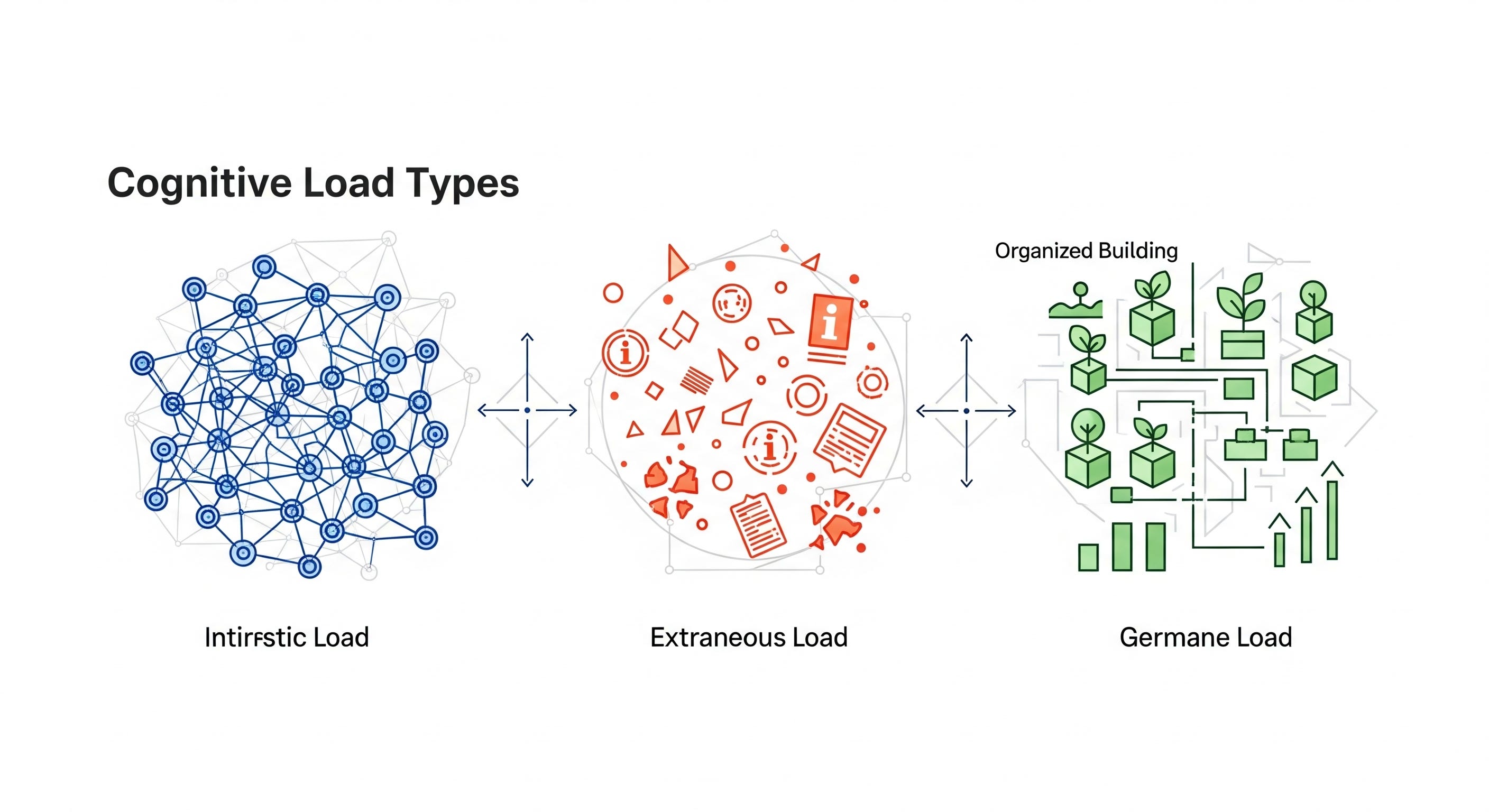
The CLT Analysis:
Intrinsic Load: Risk analysis is inherently complex and couldn't be simplified
Extraneous Load: Visual clutter, inconsistent data formatting, and scattered alert locations created unnecessary cognitive burden
Germane Load: Analysts needed support for pattern recognition and trend analysis, but the interface provided no scaffolding
The Redesign Approach: Using CLT principles, we restructured the interface around analysts' actual decision-making processes. Instead of showing all data simultaneously, we created a progressive disclosure system that surfaced information based on urgency and relevance to current tasks.
Critical alerts now appear in a dedicated, consistently located panel with standardized visual treatment. Routine metrics are grouped by functional area and hidden until needed. Most importantly, we added visual trend indicators that help analysts quickly identify patterns without holding multiple data points in working memory.
